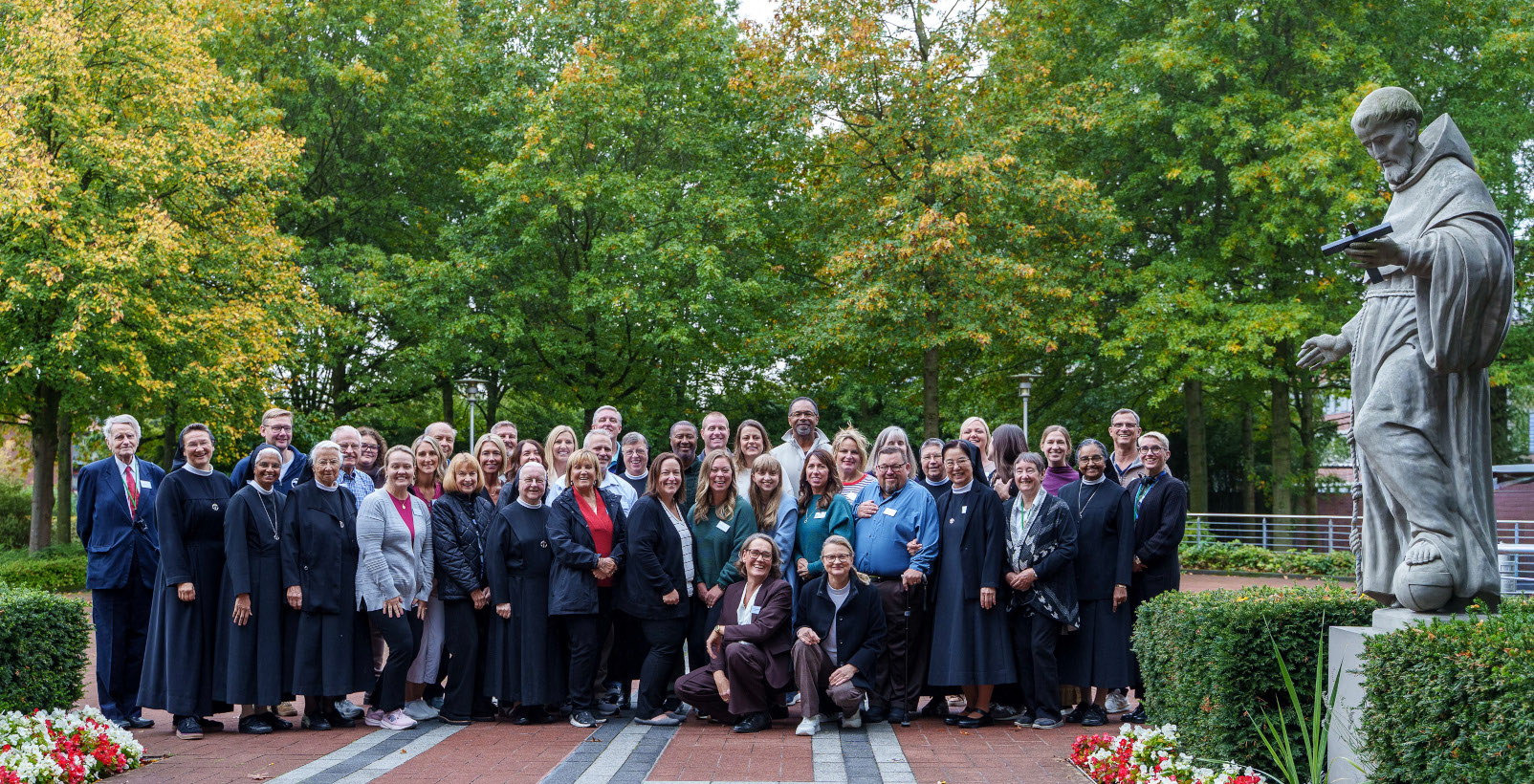
“Preserving yesterday for tomorrow, today”: This is the motto of the first International Archives Conference of the Hospital Sisters of St. Francis, which will take place in Münster from June 15–19, 2026, at the invitation of the General Administration of the international Congregation.
Among the approximately 50 participants are the superiors and heads of the archives at the Generalate and at the locations in Germany, Poland, the USA, Japan, and India. Today, the delegations from Poland and Japan were warmly welcomed at the Motherhouse in Münster; participants from the USA and India are expected tomorrow.
“Preserving our historical heritage is far more than a purely administrative task: it is a service to the memory of our community and the history of each country, as well as a testimony to our work in the world,” explains General Treasurer Sister M. Beata Kapitza, who is responsible for the Generalate Archives and is chairing the conference. “To fulfill this mission in a timely and professional manner, we would like to exchange ideas on current standards, challenges, and best-practice examples during this international conference.” In addition to reports from the various order archives, the program includes presentations by external experts as well as a tour of the archive at the Gerleve convent.
“The documentation of our international Congregation and the examination of our history demonstrate impressively how archival work can build bridges,” explains General Superior Sister M. Margarete Ulager. “We are very much looking forward to exchanging ideas on this important topic with our guests from all over the world.”
The international conference has been in preparation for several months by the Sisters and the Generalate team. The conference hall has now been fully equipped for the event—including the interpreter booths. All presentations will be available in German, English, Polish, and Japanese.
At the Catholic Day (“Kirchentag”) in Würzburg from May 14–17, 2026, the international Congregation of the Hospital Sisters of St. Francis will have a booth on the “Church Mile.”The team of Sisters from the Provinces in Germany, Poland, Japan, and India, as well as the international Generalate, will be supported by staff members from Münster.
“Our goal at the Catholic Day is to represent our international Congregation, and to engage in conversation with many people,” explain General Councilor Sister M. Hiltrud Vacker (back row, 2nd from left) and Sister M. Irmgardis Taphorn from the German Province (3rd from left), who will be reporting on the event on Instagram [@franziskanerinnenmuenster].
Anyone wishing to visit the Hospital Sisters in Würzburg will find them at booth FB-G-07 starting May 14, 2026. The motto of this year’s “Kirchentag” is “Have courage, get up!” Today, the first group of attendants received a blessing for their journey in front of the Motherhouse in Münster and set off for Würzburg.
“All our Sisters in Münster and around the world who are unable to travel to Würzburg will be with us in spirit,” the team emphasizes, “and some will also be there visually, on the two roll-up banners that will be on display at our booth.” For example, Sister M. Nichola Truong Thi Hoang Oanh from Vietnam, who has been serving as Provincial Vicaress of the Japanese Province since last October (left), as well as Sister M. Vincentia Hülskamp (with flowers), who joined the Hospital Sisters in 1963, and Sister M. Beatinis Thünemann, who recently celebrated the 65th anniversary of her profession in the Motherhouse.
Sister M. Beatinis (left) and Sister M. Vincentia are delighted that their photo will represent them – and all the Sisters who cannot travel to Würzburg – at the Catholic Day in Münster.
From Holy Thursday through Easter Vigil, Prof. Dr. Father Michael Plattig, O.Carm., celebrated the Holy Eucharist at the Motherhouse Church of the of the Hospital Sisters of St. Francis, and has summarized for us some reflections from his homilies.
“This year, on October 4, we celebrate the 800th anniversary of the death of St. Francis. I would therefore like to draw on various texts from the saint’s Testament or the Life of St. Francis by Thomas of Celano during the services of Holy Week.
In Chapter 163 of the Life of St. Francis, Thomas of Celano writes regarding the saint’s death: “When the brothers wept bitterly and lamented inconsolably, the holy father had bread brought to him. He blessed it, broke it, and gave each one a small piece to eat. He also had the Gospel book brought and asked that the Gospel according to John be read to him from the passage where it says: ‘Before the Passover, etc.’ He recalled that most holy Last Supper which the Lord celebrated with his disciples for the last time. For in honor of that memory and as a sign of the deep love he had for his brothers, he did all this.”
As a comfort to his brothers, Francis celebrates a symbolic Last Supper, in which he breaks the bread and has the Gospel of Holy Thursday read, which we have just heard. In doing so, he enters into the Passion of Christ, which begins with the Last Supper. According to Celano, there were two reasons for this: the reverent remembrance of Christ’s Last Supper and the testimony of the love Francis had for his brothers.”
Thomas of Celano makes it clear that Francis understood the Eucharist as a meal from which a mission arises, namely to carry on the love revealed in it and to act according to Christ’s example.
In the Testament of St. Francis there is a prayer that became a daily prayer in the Franciscan tradition: “We adore you, Lord Jesus Christ, – even in all your churches throughout the world, – and we praise you, because through your holy Cross you have redeemed the world.”
Compassion for the Crucified One and for the suffering becomes a central theme of his life, until he ultimately becomes the first to bear the stigmata of Christ on his own body.
The message of the Cross is not an easy one, but it is necessary, especially in our time, so that the suffering are not put off, the victims are not forgotten, and our world does not lose all humanity.
As in the Canticle of the Sun, Francis welcomes death—which is terrible and hated by all—as his Sorrella Morte, Sister Death. He sees it as part of creation and at the same time as his companion into the new reality of the new heaven and the new earth, into God’s perfected creation, through death and the Resurrection.
The Easter Vigil liturgy, too, links creation with the message of the Resurrection.
God’s creation, for all that is praiseworthy and wonderful about it, is not the final reality.
Especially in light of the current state of the world, I find this to be a comforting message. This reality, marked by the selfish lust for power of some nations and their leaders, and therefore entangled in war and suffering, is not the final word; humanity does not have the final word; we have heard it: GOD created heaven and earth, and GOD reserves the final redemption of creation for Himself.
Through Christ’s Resurrection, into which we have been incorporated through Baptism, we have a head start on creation. When it rises from sin and death, we who have risen will glorify God with it.
The death of St. Francis points to this connection, which refers to the cosmic significance of the Resurrection, encompassing all of creation. The praise of the Creator in the Canticle of the Sun culminates, in the saint’s death, in the praise of the Risen One, in the praise of the eternal God, to whom creation will follow.”
Appointment announced in a festive ceremony at Münster Cathedral
March 26, 2026. Pope Leo XIV has appointed the current Bishop of Hildesheim, Dr. Heiner Wilmer SCJ, as the new Bishop of Münster. He succeeds Bishop Emeritus Dr. Felix Genn, who retired on March 9, 2025. The announcement at St. Paul’s Cathedral by Cathedral Provost Hans-Bernd Köppen took place today on the Solemnity of St. Ludger, who was the first Bishop of Münster since 805. The installation of Bishop Wilmer as the 77th Bishop of Münster will take place on Sunday, June 28, in the afternoon.
We warmly congratulate the new Bishop of Münster on his election and wish him all the best and God’s blessing for his ministry.
The Diocese of Münster informs in a press release that Heiner Wilmer was born on April 9, 1961, in Schapen in the Emsland region. In 1980, he entered the Congregation of the Priests of the Sacred Heart and made his perpetual vows in 1985. He was ordained a priest in Freiburg in 1987. He then studied in Rome and Freiburg from 1987 to 1993. In 1991, he earned his doctorate in fundamental theology in Freiburg.
From 1993 to 2007, he worked in education, first as a student teacher in Meppen and, after passing his second state examination, from 1995 to 1997 as a teacher of religion, history, and politics, as well as a school chaplain at the Liebfrauenschule in Vechta. In 1997 and 1998, he taught German and history at Fordham Preparatory School (Jesuit High School) in New York (Bronx).
In 1998, Wilmer became principal of the Leoninum High School in Handrup. He held this position until 2007, before becoming Provincial of the German Province of the Priests of the Sacred Heart in Bonn. In 2015, he became Superior General of the Priests of the Sacred Heart in Rome. On April 6, 2018, Pope Francis appointed him Bishop of Hildesheim. Since September 2021, he has served as chairman of the Commission for Social and Societal Issues within the German Bishops’ Conference. From 2019 to 2024, he was chairman of the German Commission for Justice and Peace. In February of this year, Bishop Wilmer was elected chairman of the German Bishops’ Conference.
At the presentation of the new Bishop of Münster in the packed cathedral, in the absence of General Superior Sister M. Margarete Ulager, the Generalate of the Hospital Sisters of St. Francis was represented by General Councilor Sister M. Lima Arackal and Sister M. Laetitia Matsunaga, member of the Japan Province.
Second term of office for Provincial Superior Sister M. Johncy Kurisunkal
On Saturday, January 31, 2026, Sister M. Johncy Kurisunkal was elected as the Provincial Superior of the Indian Province of our international Congregation for a second term in office. We offer heartfelt congratulations to Sister M. Johncy and thank her for accepting again the office of Provincial Superior and the responsibility for the Province for the coming four years.
The new Provincial Leadership of the Indian Province, from left to right: Provincial Superior Sister M. Johncy, Provincial Vicaress Sister M. Riji, and Provincial Councilors Sister M. Stella and Sister M. Renita.
The Sisters of the newly elected leadership team serving on the Provincial Council are: Sister M. Riji Kannampuzha, Provincial Vicaress, Sister M. Stella Madathil, Provincial Councilor and Sister M. Renita Thenakarayil,Provincial Councilor. Sister M. Riji and Sister M. Stella are elected for a first term in office. Sister M. Renita is elected for a second term in office and served as Provincial Vicaress in her previous term. The determined number of the members of the provincial leadership at the Provincial Chapter of the Indian Province, is four Sisters.
Congratulations to the new Leadership team by General Superior Sister M. Margarete Ulager
We especially thank the newly elected Sisters for accepting the call to a ministry in provincial leadership at this extraordinary time in our world. To Sister M. Tessy and Sister M. Mercy former Provincial Councilors we extend our sincere gratitude for their faithful service in provincial leadership of the Indian Province during their terms in office. May God richly reward them for their dedicated ministry.
On January 23, 2026, the ‘Ordinary Provincial Chapter of Election’ of the Indian Province of our Congregation opened with the theme: “Eph’ phatha – Be Opened”.Historically, it is the eights chapter and the fourth Provincial Chapter of the Indian Province after the Region became a Province in 2013.
General Councilor Sister M. Teresa Wawrowicz, a member of the Polish Province, spent Christmas and New Year‘s Eve with Sister M. Weronika Jerzewska in Kamyschenka. A report from the Polish mission of our Congregation in Kazakhstan.
The mission in Kazakhstan was opened in 2009 and began its work in Shchuchinsk. For a time, four of our Sisters worked there: Sr. M. Benita, Sr. M. Weronika, Sr. M. Rufina, and Sr. M. Arturis. Their presence was a true gift for the people of Kazakhstan. With great commitment and kindness, they shared the daily lives of the people and brought them help and the witness of faith. Their service was marked by many hardships, sacrifices, and challenges, which they accepted with love and fidelity to their vocation. We are deeply grateful for this.
In 2017, the Polish Province established a second mission in Kamyschenka; the mission in Shchuchinsk was closed in 2020. Sr. M. Arturis was the first to return to Poland, followed by Sr. M. Rufina. Unfortunately, Sr. M. Benita also had to return to Poland due to illness. Only Sr. M. Weronika remained in Kazakhstan and remains faithful to the mission entrusted to her to this day.
So that she would not be completely alone, the Sisters of the Polish Province took care of her and sent concrete support. Some of them agreed to visit her and spend some time with her, sharing her daily life and strengthening her through their presence. The Sisters of the Generalate also accompany Sr. M. Weronika continuously through their closeness, their interest, and their responsible care for the mission. It is our task to be there for our Sisters; therefore, Sr. M. Margarete asked me if I was willing to go to Kazakhstan.
There could hardly have been a better time to travel there and spend time together than the Christmas season. So, on December 15, 2025, I set off for Kazakhstan via Warsaw and arrived in Astana on the morning of December 16. Sr. M. Weronika and Father Tomasz were already waiting for me at the airport. Not only were their hugs warm, but they had also brought a thermos of hot coffee and delicious sandwiches. At that point, I didn‘t know how difficult the weather conditions were due to heavy snowfall and strong winds, and that many roads were already closed. We still had about two hours to drive to our destination. This was my first experience of the roads in Kazakhstan. At first, the visibility was comparable to flying through clouds. I thought it couldn‘t get any worse. But in the end, the drive took us over a frozen riverbed, through the steppe, and over packed snow full of ruts and snow drifts. I felt a bit like I was in an off-road rally.
When we arrived at the convent, we celebrated Holy Mass. Afterwards, Sr. M. Weronika invited us to lunch. The following days became increasingly intense. Preparations for Christmas were in full swing: the church was decorated, altar cloths for all the chapels were ironed, the nativity play was rehearsed with the children, and the convent was prepared. We also visited all the sick people. This took a lot of time, as the parish includes six villages that are many kilometers apart. We visit these places regularly because the people long to participate in the Eucharist.
Sister M. WeronikaSister M. Teresa
The people here are very devout and truly remarkable. Their hospitality, openness, and generosity touched me deeply. Some brought homemade provisions or pastries, and one woman even gave us a roast duck. In addition, the people who live here are characterized by their extraordinary resilience in the face of the hardships of life. Living conditions are very difficult. The extreme temperatures alone are a major challenge: in winter there is severe frost, and in summer it can get incredibly hot. People have learned to endure these conditions, and I saw farmers working in the fields at -25°C.
Missionary work here also requires extraordinary perseverance. I am full of admiration for the ministry of Father Tomasz and Sister M. Weronika, who often need the whole day to reach people living in remote areas and enable them to encounter Christ in the Eucharist. For me personally, the time spent here is a wonderful gift. It allows me to look intensively at the meaning of our charism, to bring the healing presence of Christ to people. I have paused here for a moment to look, listen, reflect, and delve deeper into the mystery of our Franciscan way of life.
Letter by Sister M. Margarete Ulager, General Superior of the Congregation of the Hospital Sisters of St. Francis
Muenster/ Germany, January 8, 2026.
Dear Sisters, Dear colleagues, Dear friends,
Today, January 8, 2026, we received the sad news from Sister Maureen O’Connor, Superior of the U.S. Canonical House, that our dear Sister Sherrey Murphy, OSF, passed away suddenly and unexpectedly at 8:20 a.m. (American time).
Only two months ago, at the beginning of November, we met Sister Sherrey in good health during the celebrations for the 150th Anniversary of the presence of our Sisters in the USA, as shown above in the photograph of all the Superiors of our international Congregation.
It is with heavy hearts that we say goodbye to Sister Sherrey.
Sister Sherrey spent 24 years in Germany, 12 years as General Councilor and 12 years as General Superior.
We are deeply grateful for the time we spent together, and for all she has done in her life, and as General Superior of our Congregation – for each individual Sister, for our international Congregation, and far beyond. May God reward her for all her goodness. Now, hidden in the mystery of eternity and close to God, she is surely a great intercessor for us.
We extend our heartfelt and deep sympathy to Sister Sherrey’s family, Sister Maureen O’Connor, Superior, all the Sisters of the U.S. Canonical House and the staff. We are certain that Christ, our Lord, stood at the sea shore of her life when Sister Sherrey embarked on her final journey. There, He surely welcomed her with wide, open arms. May Sister M. Sherrey rest in peace!
With love and deepest gratitude,
Sister M. Rita, Sister M. Lima, Sister M. Hiltrud, Sister M. Teresa, Sister M. Beata, Sister Christa Maria, Sister M. Laetitia, Father Michael Plattig, all the staff at the Generalate, Hildegard Benölken (Sister Sherrey’s long-time secretary) and
Sister M. Margarete Ulager General Superior of the Congregation of the Hospital Sisters of the Third Order Regular of St. Francis
In memoriam Sister Sherrey Murphy, OSF, 1942 – 2026, General Superior of the Hospital Sisters of the Third Order Regular of St. Francis from 2006 to 2018.
Hospital Sisters of St. Francis and “Wolltäterinnen” (“Wool Workers”) hand over donation
Muenster, January 7, 2026. From November 21-23, 2025, the traditional charity Christmas bazaar took place once again in the foyer of St. Francis Hospital in Muenster—a joint project of the Hospital Sisters of St. Francis and the creative group of employees at St. Francis Hospital, the “Wool Workers.” With popular classics such as hand-knitted socks, warm hats and scarves as well as Christmas decorations, the craftswomen raised a total of €7,600. In December, they donated the money to the “Babylotsen” (“Baby guides”) program based at St. Franziskus Hospital which helps babies and young families, and to the hospital’s pediatric clinic.
“Baby guide” Hjördis Bayer as well as Dr. Meike Franssen, head physician of the Clinic for Pediatric and Adolescent Medicine, and Dr. David Lewers, Commercial Director of the hospital, expressed their gratitude to the organizers of the bazaar. “We are very pleased about this wonderful donation, which will help us to support children, their mothers, and their families in difficult situations and to have a positive influence on their lives even after their stay in the hospital”, Dr. Lewers said.
More information on the Sisters who contribute to the bazaar can be found in last year’s report.
During the Jubilee Year 2025, many of our international Congregation’s Sisters and staff traveled the world as “pilgrims of hope.” In Rome, they attended papal audiences (some with Pope Francis, others with Pope Leo XIV.) and passed through the Holy Doors; they made pilgrimages to various spiritual places in Rome, Subiaco, and Assisi, for example, as well as in Malta, China, and their respective home countries.
At the Generalate, we have selected some of the impressions and moving moments of these international pilgrimages and compiled them in a video that we would like to share with you at the end of this Jubilee Year. All the pilgrims shown here always carried in their hearts all those Sisters of our international Congregation who were unable to make the journey themselves.
The film is presented by General Councilor Sister M. Hiltrud Vacker, Claudia Berghorn (International Communication at the Generalate), and Dr. Ulrike Teßarek (Value Management at the St. Francis Foundation), who traveled to Rome together in June 2025.
All the Sisters and staff at the Generalate wish you a peaceful and blessed New Year! May God bless and protect you and all those who are dear to you.
PACE E BENE!
By the way: You can find this film and many further interesting videos in the media section of our website.
The series “Pilgrims of Hope” is a monthly spiritual contribution to the Holy Year – a collaboration between the international Generalate of the Hospital Sisters of St. Francis and the Muenster-based German church publication “Kirche und Leben” (“Church+Life”). Our topic in December: Hope for Dignity
Human dignity is inviolable: how wonderful it would be if this sentence were not only enshrined in our German constitution, but were also a matter of course throughout the world. Yet even today, many people still have to fight for their dignity and suffer from exclusion, injustice, and hardship. Sometimes entire groups are affected because of their religion or because of wars and natural disasters; sometimes it is personal misfortunes or illnesses that push people to the margins of society. Especially in December, when we await the arrival of our Lord, I think about this particularly often. For as romantic as the birth in a stable is portrayed today, the Holy Family would certainly have preferred to make themselves comfortable at home.
Also, I think of the patron saint of our Congregation, St. Francis of Assisi, who dedicated his life to the sick and marginalized. One of his most formative and fateful encounters was that with a leper outside the gates of Assisi. At that time, people suffering from leprosy lived outside the city. But even today, leprosy still exists, as does this marginalization – for example in India, in Ramgarh in the state of Jharkhand. Since 1982, the Sisters of our international Congregation have been supporting people in a leprosy settlement there – both medically and by enabling their children to attend school. Health and education: two important aspects for a life of dignity.
Sister M. Stefania Gembalczyk (left) with Sisters from our Indian Province in the Ramgarh convent
The convent in Ramgarh was founded by Sister M. Vulmara Hannöver, who was the first Hospital Sister of St. Francis to go from Münster to India in 1973. From 1989 onwards, one of our Polish Sisters, Sister M. Stefania Gembalczyk, was particularly involved in Ramgarh. For more than 25 years, she cared for leprosy patients as a nurse; they called her “our Mother Theresa.”
In addition to health care, our Indian Sisters in Ramgarh are primarily involved in education. Two years ago, they opened a new English-language school, which now teaches 914 children.
During my visits there, I have seen for myself how important the work of our Sisters in Ramgarh is. Once, it was already dark when we reached the leprosy colony. Open fires lit up the narrow streets and cast a soft light on the people who lived there. They invited us into their poor huts – huts that resembled the depictions of the stable in Bethlehem. Later, we met an old man; he greeted us warmly by leaning forward and raising his hands to his forehead – or so we thought. Then we realized that he no longer had hands, only stumps.
He was very happy about our visit, but sad that we had come so late. And he asked us to come back during daylight hours so that he could see our faces. Although this old man was scantily clad in rags, he radiated great dignity. His invitation touched our hearts deeply. We felt small and ashamed—tears welled up in our eyes in the darkness.
In the light of the Holy Night, this memory has a special impact. God invites us into the poor huts of this world. He invites us into the poor stable in Bethlehem so that we can see Jesus Christ, who became man and already gives us “prestige” through the mystery of his love. He gives us his light and a dignity that can never be taken away from us. For “in him was life, and that life was the light of men. And the light shines in the darkness.”
Our faith is visible in the way we treat people, regardless of illness or social position. The child in the manger is the guarantee that human beings will never lose their royal dignity. Today more than ever, it is important for us Christians to bear personal witness to the healing presence of God. Let us pray for one another that our faith in the incarnation of God may deepen. Looking at Jesus Christ, our Lord, who was born in a stable, we see all those people who have become homeless, poor, and sick, who are hungry and have to endure suffering; the list is long. Christmas invites us to listen anew to God’s word and to seek His will for us and for our Church at this moment in our history.
By Schwester M. Margarete Ulager and Claudia Berghorn
This article was published in German, online and in print, in the Diocese of Muenster’s magazine, “Kirche+Leben” (Church+Life), in December 2025.
Christmas letter of Sister M. Margarete Ulager, General Superiour of the Hospital Sisters of St. Francis
Dear Sisters, dear colleagues, dear friends,
On Christmas Eve, December 24, 1968, three US astronauts – Frank Borman, William Anders, and James Lovell – reached the moon aboard Apollo 8. From there, the astronauts sent back to Earth what were probably the most distant Christmas greetings in history. The three astronauts had set off on the first manned moon flight three days earlier, on December 21, 1968. The NASA mission was intended to photograph the lunar surface and find a suitable landing site for a future moon landing. But on Christmas Eve, December 24, 1968, during the fourth of a total of ten planned orbits around the moon, something completely unexpected happened: the astronauts suddenly saw the far side of the moon, and the Earth “rise” above the moon’s horizon in the vast universe, in infinite silence, similar to how one sees the Moon rise on Earth. Amazed by this magnificent sight and by how small our Earth seemed in the vastness of space, astronaut Frank Borman became deeply aware of the presence of God and our humble human reality on Earth. To everyone’s surprise, he said a prayer:
Grant us, O God, the ability to see Your love in this world, despite our human failings.
Grant us the faith to trust in Your goodness despite our ignorance and weakness.
Grant us insight so that we may not cease to pray with an understanding heart.
And show us what each of us can do to bring peace to the world.
Frank Borman, US Astronaut, December 24, 1968
This historical review reminds us that the feast of the Incarnation of God is not a simple event on the calendar, not an event in the annual cycle, not a historical milestone in the course of the centuries. Rather, it is the ALMIGHTY WORD (John 1:14), born into our human being, when deepest silence enveloped the universe and night in its swift course was half spent (Wis 18:14), the fundament and source of all life.
We sincerely wish you and all those close to your heart a blessed, peaceful, and grace-filled Christmas and all the best for the New Year.
Thank you very much your prayers and for all your support! May the Christmas Star shine gently or brightly upon us in 2026, just as we need it.
With heartfelt greetings and best wishes for the New Year from Father Michael Plattig O.Carm. and your Sisters: Sr. M. Rita, Sr. M. Lima, Sr. M. Hiltrud, Sr. M. Teresa, Sr. M. Beata, Sr. M. Laetitia, Sr. Christa Maria, as well as our team,
For around 2.5 billion Christians worldwide, Advent is a very special time in the Church year: a time full of anticipation and preparations for Christmas, the celebration of the incarnation of our Lord. A time of silence, reflection, and diverse traditions.
We wanted to take a closer look at these traditions and asked the members of our multinational and multicultural community how Advent is celebrated in their home countries. The result: there are many similarities! At all our locations, festive Advent services are celebrated, candles are lit on Advent wreaths, and the doors of Advent calendars are opened every day in December. The wait for Christmas is also used everywhere as a time of prayer and spiritual reflection. And light plays an important role: lights in dark times, the star on the horizon: for the Lord is coming. But there are also differences.
Advent with our international Sisters at the Motherhouse in Münster, from left to right: Sister M. Laetitia with a poinsettia, which is just as popular in Japan as it is in Germany. Sister M. Lima shows a “Stutenkerl” and Sister M. Benedikte a shoe that was filled by St. Nicholas. Sister M. Teresa presents homemade gingerbread from the Polish Province.
Germany
In Germany, on the eve of December 6, children place their nicely polished shoes or boots outside the front door – and in the morning, they find small gifts and sweets from St. Nicholas. The “Stutenkerl”, a traditional German pastry, is also said to represent this Saint. In the past, as a sign of blessing, the pastry was given to the sick or those who were unable to attend church.
The beginning of Advent is celebrated in the Motherhouse Church in Münster with a particularly solemn vespers service. During the service, a priest lights the first candle on the Advent wreath while the Sisters sing the song “Wir sagen Euch an den lieben Advent…” (We announce to you the beloved Advent…). For several years now, a festive charity concert with Christmas carols has also been held in the Motherhouse Church in aid of Johannes Hospice in Münster. 400 candles burned at the “Christmas Carols 2025” on December 7, 2025, with the Münster Concert Choir; many children also took part. The impressive light show and our organist Markus Schröder also contributed to the great success of the concert.
I remember a tradition from my elementary school days: during Advent, every child who had done a good deed placed a straw in the manger so that the divine child could be softly bedded at Christmas.
Sister M. Benedikte
What would Advent be without cookies? At our Motherhouse in Münster, our Vietnamese Sisters baked lots of cookies with Sister M. Vera and then decorated them with chocolate with Sister M. Rita in the Generalate kitchen. The Sisters also traveled to the convent in Kroge for an Advent visit.
Poland
In many areas of Poland, children symbolically bring light to people’s homes, and nativity scenes and Advent cribs are lovingly crafted in monasteries. The Sisters of our Polish Province offer spiritual and material assistance by organizing Christmas packages for the needy, and offering meetings and conversations with socially marginalized people.
One of the most characteristic features of Advent in Poland is the Rorate Mass – a liturgy celebrated in honor of the Blessed Virgin Mary in the early hours of the morning, usually before sunrise. Participants bring candles or lanterns symbolizing the expectation of the coming “Light of the World” – Jesus Christ.
Sister M. Teresa
In Oldrzychowice in our Polish Province, Sister M. Franciska Wanat and several volunteers organized a visit from St. Nicholas for children affected by the flood disaster of September 2024. Fifty-two children took part in the event and spent a wonderful afternoon together.
USA
In the USA, Advent calendars have 25 doors because Christmas is not celebrated on Christmas Eve, but on Christmas Day, December 25.
I love to sing Advent songs to prepare for the coming of our Lord. I discovered Handel’s Messiah about 40 years ago and listen to it often. When I was a child the crib was very special in our home. In the Novitiate we practiced the spiritual building of the crib with special thoughts each day.
Japan
In our convent in Himeji, we have been using purple and pink candles for about 20 years, which we brought back from the Korean mission. Purple represents repentance, pink represents joy. As the colors of the candles change from three deep purple to three light purple and then to one pink candle, Christmas draws nearer.
Our community has adopted the tradition of the Missionaries of creating a “spiritual manger.” We prepare to welcome Christ by building this manger and laying “straw” in our hearts, gathering prayers, sacrifices, and good deeds.
Sister M. Laetitia
Indien
In some regions of India, rose cookies, kulkuls, and fruit bread are baked during Advent. Through social media and parish groups, many also take part in charity activities and outreach programs, making Advent a time not only for spiritual preparation but also for sharing love and joy with others.
In India, a land rich in prayer, color, and celebration, we understand deeply what it means to wait with expectation — for the monsoon rains, for the harvest, for light to overcome darkness. As we light the Advent candles, I am reminded of the diyas (lamp) we light during Diwali — both shining as symbols of hope and the triumph of light over darkness, of God’s presence in our lives.
To all my sisters around the world: may this Advent help us rediscover the beauty of waiting — not with anxiety, but with peace and trust. May our hearts become humble cradles of hope, ready to receive the Prince of Peace. And may our lives, wherever we are, shine like little lamps, spreading the warmth and light of Christ’s love to all we meet.
Sister M. Renita
We would like to thank the Sisters of our international Congregation who sent us information about Advent in their home countries: Sister M. Benedikte (Germany), Sister M. Teresa (Poland), Sister Janelle (USA), Sister M. Laetitia (Japan), and Sister M. Renita (India).
The series “Pilgrims of Hope” is a monthly spiritual contribution to the Holy Year – a collaboration between the international Generalate of the Hospital Sisters of St. Francis and the Muenster-based German church publication “Kirche und Leben” (“Church+Life”). Our topic in November: Hope for Respect
Another year is drawing to a close. Beginning with All Saints’ Day and All Souls’ Day, November is traditionally a month in which we look back on our own lives and on the lives of those who came before us. It is often a reflective time. Many people think about what has become of their plans of the year’s beginning, and what they have already achieved in their lives overall. And when we light candles on the graves of our deceased loved ones, this gesture is also an expression of respect for their lives, and their achievements. This is also the case with us Hospital Sisters of St Francis.
Our international Congregation’s 180-year history is marked by strong female leadership, pioneering spirit, and courage. In terms of their careers and their position in society, our Sisters were often ahead of their time. Women have always held leadership positions in the institutions founded by our Congregation. In their hospitals, not only was the care of patients entirely in the hands of the Sisters, but so was the overall management. For a long time, women in religious orders were able to realize their professional potential much more freely than women outside a convent: in Germany, for example, married women were not considered legally competent until 1969, and until 1977, if they wanted to get a job, they had to ask their husbands for permission. At that time, Sister M. Ambrosina Bettmer was in charge of St. Francis Hospital in Münster with a team of several hundred Sisters and civilian employees.
Traditionally, all the young women who joined our Congregation studied nursing – but depending on the positions and tasks that needed to be filled in the congregation, this training was often not the only one. This was the case for Sister M. Dietmara Ahlmann, born in 1937: when the order’s leadership decided in the early 1960s to provide dental care for the many Sisters in Münster “in-house,” Sister Dietmara was chosen for this task.
Dentist Sister M. Dietmara Ahlman in her practice at St. Francis Hospital
The trained nurse completed her high school diploma through adult education and, as the only woman in her year, studied dentistry at Münster University from 1968 onwards. As a dentist, she then cared for her fellow sisters for 35 years in a fully equipped practice in the basement of St. Francis Hospital. At the same time, she was active in the Provincial and General Administration from 1983 onwards and traveled to the Provinces and projects of our Congregation in Japan, Taiwan, Korea, India, the USA, Haiti, Arizona, Poland, and Czechia.
General Councilor Sister M. Dietmara (2nd from the right) visiting the Medical Sisters of St. Francis in India
Our Sisters were also characterized by a pioneering spirit, setting out into the world for missionary projects, combined with courage drawn from the strength of their faith. One example is the young women who, 100 years ago, in September 1925, left the American Province of the Hospital Sisters of St. Francis for Tsinan (now Jinan) in China to build a hospital there. Beforehand, there was an application process among the American Sisters for this mission, searching for volunteers “in good health and younger than 40”. It went without saying that they had to be trained nurses. Sixty-seven Sisters applied; five were ultimately selected. The youngest of them, 29-year-old Sister Evangelista Sanders, paid for her courage with her life: she died after only a year and a half of her service. However, the presence of the Hospital Sisters in China continued until the Sisters were expropriated and expelled by the Communist regime after World War II. Two of the Sisters fled to Shanghai, from where they were called to Japan in 1948 to take over a hospital in Nagasaki – the nucleus of today’s Japan Province.
Sister Engelberta Beyer and Sister Euphrosine Fischer in China, 1926
We remember all these Sisters with great respect. But our respect also extends to those of our fellow Sisters who had less eventful lives, and who served and continue to serve quietly and faithfully, whether in a hospital, a school, or a parish, whether in housekeeping or in contemplation and prayer. In keeping with the spirit of our patron saint, St. Francis of Assisi, we actually look upon the life of every human being with the greatest respect: each and every one of us is placed in this world with individual abilities and hopes, with goals and challenges. On our journey through life, sometimes we succeed, sometimes we don’t. That, too, is deeply human. So as we look back now in November, we should always appreciate our efforts – with respect, and with the eyes of love.
By Schwester M. Rita Edakkoottathil and Claudia Berghorn
This article was published in German, online and in print, in the Diocese of Muenster’s magazine, “Kirche+Leben”(Church+Life), in November 2025.
The series “Pilgrims of Hope” is a monthly spiritual contribution to the Holy Year – a collaboration between the international Generalate of the Hospital Sisters of St. Francis and the Muenster-based German church publication “Kirche und Leben” (“Church+Life”). Our topic in October: Hope for Future
“The Future of Thinking” — this was the recent cover story of the weekly newspaper Die Zeit. It featured a major interview with the American scientist, inventor, and entrepreneur Ray Kurzweil (77), who has been fascinated by technology since childhood and has contributed to the development of artificial intelligence ever since he first encountered a computer in New York in 1960, at the age of twelve. Kurzweil is convinced that in just four years, by 2029, AI will be more intelligent than humans. It will then be possible, he says, to make that knowledge directly accessible to humans through implants in the brain. “Merging with AI is the only way not to be dominated by it,” says Kurzweil, without offering any ethical evaluation of this development.
What is possible — and what is right? Are we allowed to do everything that is possible? These questions have always occupied humanity, not only in science and technology, but also when it comes to our personal life paths. That was already true in the 13th century. Back then, the patron saint of our religious community, Francis of Assisi, the son of a wealthy merchant, could have chosen a life of luxury and comfort. Yet after personal, physical, and spiritual crises, he decided at the age of 25 to take the more difficult path, the one that was right and meaningful for him. Inspired by the Gospel, he gave away his worldly possessions to serve God and others. He could not have foreseen how profoundly his decision would shape the future: many people joined him, and to this day, the Franciscan orders and lay communitiescelebrate his life and work every year on the Feast of St. Francis in early October.
Predicting the future remains impossible, even with AI. We can only try our best to prepare for the challenges that new developments bring. And we can take a stand when it comes to the Christian and Franciscan values that guide us and will continue to shape our life and work in the future: to refuse to reduce people to their thinking and performance, and instead to see each person as a unique and precious creation of God — as a whole being of body, soul, and spirit.
Since the founding of our community in 1844, this holistic understanding has guided our commitment to people in sickness, old age, and need. It also shapes the education and formation through which we prepare the young members of our international order for their future. Of course, the young women in Poland, Japan, and India receive solid professional training — for example, to become nurses, doctors, teachers, social workers, pastoral assistants, auditors, lawyers, or theologians, and eventually to take on leadership roles within our community. The curriculum includes English as the common language of our congregation, as well as the traditions and customs of each culture — such as special dances or the tea ceremony. At the same time, we emphasize deep spiritual and emotional formation, enabling our sisters to bear witness through their service to God and humanity, and to live a human life in all its fullness — a life in which AI will surely play a role in the future, both on the curriculum and, hopefully, through medical progress that our sisters can use for the good of their patients.
Returning to Ray Kurzweil: he leaves no doubt that he considers some developments inevitable, saying, “The advancement of AI is a global competition — if we don’t take part, other countries will.”
Perhaps we Christians should claim the freedom to start a parallel competition for the future, a competition in humanity. Because if we don’t lead the way, who will?
New Provincial Leadership of the Japan Province Elected
Shortly after the conclusion of the Provincial Chapter of the German Province, the Provincial Chapter of the Japan Province began on October 10, 2025, in Himeji under the theme “God Is with Us – Burning Hearts, Stepping Feet.”
Election of the New Provincial Leadership
On October 13, 2025, Sister Maria Fidelis Furukawa was re-elected Provincial Superior of the Japan Province for a second term of office. As a Congregation, we extend our sincere congratulations and gratitude to Sister Maria Fidelis for her willingness to once again take up this important ministry.
Sister M. Nichola Truong Thi Hoang Oanh was elected Provincial Vicaress and First Provincial Councilor. We thank Sister M. Nichola wholeheartedly for accepting this service and for her readiness to serve the Japan Province in this new role. We ask everyone to remember the newly elected Provincial Superior and Vicaress in prayer – they rely on our support.
In the afternoon of the same day, the Capitulars continued the election process and chose the following Sisters as Provincial Councilors:
Sister M. Theodora Wakatsuki
Sister M. Philippa Sato
Sister M. Martina Du The Thanh
We warmly congratulate each Sister on her election and thank them for accepting the ministry of service in the Provincial Leadership.
On the evening of October 13, 2025, Sister Maria Fidelis and the newly elected Councilors were officially installed during Vespers. Father Prof. Dr. Dr. Michael Plattig bestowed his blessing upon them, saying:
“The foundation of all our actions is the conviction that God is always with us. May you walk in this faith and trust, guided by the Holy Spirit, with a listening and loving heart.”
Sister Maria Fidelis, Sister M. Nichola, Sister M. Theodora, Sister M. Philippa, Sister M. Martina
Gratitude for the Former Provincial Council
We express our heartfelt thanks to Sister M. Vianney Kawaguchi, Sister M. Pacis Kyonoku, and Sister M. Goretti Vien Tran Nha Quyen for their dedicated service as Provincial Councilors during the past term.
New Provincial Leadership of the German Province Elected
Shortly after the conclusion of the Provincial Chapter of the German Province, the Provincial Chapter of the JapUnder the motto “Pilgrims of Hope,” we were able to experience days of prayer, exchange, counsel, and decision-making.
Spiritual Opening
Father Michael Plattig opened the chapter with a Eucharistic celebration in which he invited us to trust in the Spirit of God—and at the same time to celebrate the chapter as a feast. A special sign was the lighting of the chapter candle by Sr. Leemary, a symbol of the light of the Holy Spirit that accompanied us.
Work and Spiritual Impulses
Sr. M. Margarete, in her reflection on the theme “Pilgrims of Hope,” provided a valuable foundation for exchange and shared reflection. Our days were marked by discussion groups, times of prayer, a daily bibliolog, and the sharing of personal stories of hope. In this way, a deep sense of connection and orientation toward the future grew.
Gratitude and Remembrance
During Vespers, we commemorated with reverence the 104 sisters who passed away over the past four years. Their witness remains alive in our community.
Election of the New Provincial Leadership
On September 13, the electoral chapter began under the chairmanship of our Superior General, Sr. M. Margarete, and moderator Sr. Ruth Pucher. We joyfully announce the newly elected provincial leadership:
Sr. M. DiethildeBövingloh
Sr. MarianneKamlage
Sr. LeemarySebastian
Sr. M. VeraLütkebohmert
We thank them for their willingness to take on this service and wish them God’s abundant blessing.
A festive evening, a shared pilgrimage to Telgte—our place of foundation—and the solemn signing of the closing document rounded off these days.
With great gratitude, we look back on the 2025 Provincial Chapter. Strengthened by shared prayer and carried by God’s encouragement, we continue our journey—as Pilgrims of Hope.
Sister Leemary, Sister M. Diethilde, Sister Marianne, Sister M. Vera
Gratitude for the Former Provincial Council
We express our heartfelt thanks to Sister M. Cäcilia for her dedicated service as Provincial Councilor during the past term.
The series “Pilgrims of Hope” is a monthly spiritual contribution to the Holy Year – a collaboration between the international Generalate of the Hospital Sisters of St. Francis and the Muenster-based German church publication “Kirche und Leben” (“Church+Life”). Our topic in September: Hope for Support
A year ago, in mid-September 2024, large parts of Eastern Europe were hit by heavy rain and flooding. Many people lost their lives. In Poland, the region where the Hospital Sisters of St. Francis have been active since 1848 was particularly affected: when a dam broke, a flood wave poured into the Lower Silesian town of Ołdrzychowice Kłodzkie, home to the Motherhouse of our Polish Province. Roads, walls, cars, fences, and trees were simply swept away, and houses were flooded. When the water finally receded, the full extent of the devastation became apparent.
View from the Motherhouse of the Polish Province after the flood
At that time, the Provincial Superior of the Polish Province, Sister M. Maksymiliana Pilarska, was in Münster with a delegation of fellow Sisters to attend the General Chapter of the international Congregation. “Half of our group traveled back to our Motherhouse as quickly as possible,” she recalls today. What the Sisters found exceeded their worst fears. “The buildings were filled with water meters high. There was no electricity, no heating, no fresh water, no telephone, no internet.” Even a year later, the renovation work is still not complete.
Sister M. Stella Kowalska helped provide warmth and food
But looking back, it is not only horror that stands out, but also gratitude. “The support we received in this emergency situation was incredible – both locally and internationally.” This support came from neighbors, people from the region, the Polish government, the Sisters’ families, and the international Congregation. “The Generalate, our International Leadership in Münster, procured generators, drying equipment, and materials that were immediately sold out in our region,” reports Sister Maksymiliana. “They also provided medicine, water, food, and much more.” The German Province of the Congregation, the St. Franziskus Foundation, and the St. Antonius Parish in Münster also participated in the emergency aid, as did the shipping company Fiege Healthcare Logistics, which provided transportation. Urgently needed financial aid also came from Münster and from many people in Poland and around the world. By November 2024, the Sisters had received 369 monetary donations, both small and large. The Sisters shared their materials and funds with other affected people in the area. “We would like to once again express our heartfelt thanks to all our supporters,” emphasizes Sister Maksymiliana.
Provincial Superior Sister M. Maksymiliana Pilarska after chopping wood for the stoves
“The fact that we can help each other in times of need is one of the great gifts of our internationality,” says the Superior General of the Mauritzer Franciscan Sisters, Sister M. Margarete Ulager. However, the Franciscan Sisters’ worldwide aid is not limited to acute situations or to their own community. The sisters in the USA, who have been active in health care since 1875 and have founded many hospitals in the Midwest, have launched “Mission Outreach”: Based in Springfield, Illinois, the organization addresses the urgent medical needs of people in resource-poor areas around the world by collecting medical supplies and equipment from US hospitals, sorting them, repairing them if necessary, and then distributing them to hospitals and medical aid organizations worldwide. Mission Outreach’s biomedical engineering department tests and manages 700 medical devices and their associated consumables each year. The organization can count on the support of more than 300 volunteers to pack, inventory, and ship the relief supplies.
“Mission Outreach” is supported by more than 300 volunteers
Since its founding in 2002, it has saved more than $85 million worth of medical supplies and equipment that would otherwise have ended up in landfills. It has already supported 530 medical aid organizations worldwide; and in August 2024, the Mission Outreach team was delighted to reach its 100th country with a delivery to Burundi.
“What can I personally do to alleviate suffering – here and now, with my resources and capabilities?” This question already moved our namesake, St. Francis of Assisi, 800 years ago. He gave away all his worldly possessions and dedicated his life to serving God, and the sick and marginalized. Inspired by his example, we Hospital Sisters have been searching for new answers to this question ever since our Congregation was founded in 1844. And we have gratefully accepted the support we have been given. For example, from Leoś, a 10-year-old Polish boy: with the money he received as a gift for his First Communion, he bought a dehumidifier for the Sisters in Ołdrzychowice Kłodzkie.
By Sister M. Beata Kapica and Claudia Berghorn
This article was published in German, online and in print, in the Diocese of Muenster’s magazine, “Kirche+Leben”(Church+Life), in September 2025.
The series “Pilgrims of Hope” is a monthly spiritual contribution to the Holy Year – a collaboration between the international Generalate of the Hospital Sisters of St. Francis and the Muenster-based German church publication “Kirche und Leben” (“Church+Life”). Our topic in August: Hope for Arrival.
Pilgrimages have been very popular for some time now. One example is the Way of St. James or “Camino”, which was designated a European Cultural Route by the Council of Europe in 1987 and is highly recommended. The official website of the German Way of St. James headquarters states that in the “record year” of 2024, almost half a million people traveled the “Camino” for the first time. They came from almost 200 countries, with pilgrims from Germany statistically ranking fourth – after Spain, America, and Italy.
The media also plays a major role in the growing awareness and popularity of pilgrimage routes. After German comedian and author Hape Kerkeling published his travelogue “Ich bin dann mal weg” (I’m off then) in 2006, the number of Germans on the Camino rose so sharply that statisticians even speak of a “Kerkeling effect.” The thousands of photos of the beautiful landscape posted on social media are also fueling this trend.
View from Subiaco Monastery
Even if modern pilgrimages are not always religiously motivated, there is often a spiritual longing behind them: the search for the essential, for one’s own path, and ultimately for the meaning of life. Many associate the pilgrimage experience with the hope of finding themselves. This begins long before the actual journey, when pilgrims plan their hiking stages, leave everyday life behind and consider what is absolutely essential in a backpack that, in the best case, weighs only six kilos.
It’s easier to travel with light luggage: pilgrimage has always been a metaphor for the journey of life. Its first boom can be traced back to the Middle Ages. Even then, Santiago de Compostela was one of the three most important Christian pilgrimage destinations, alongside Jerusalem and Rome. Our namesake, Francis of Assisi, made a pilgrimage there at the beginning of the 13th century – and as the son of a wealthy merchant family, he was one of the few who could afford to do so. In this Jubilee Year 2025, more than 40 million pilgrims are expected in the Eternal City, responding to Pope Francis’ call and invitation to be “pilgrims of hope.”
Among them will be several Sisters of various nationalities from our international Congregation, including German, Indian, and Japanese. Other Sisters from our German province, for example, have made a pilgrimage to Gerleve on the Ludgerusweg, and Sisters from the Japanese province have followed in the footsteps of St. Francis and St. Philip to Assisi and Florence.
All pilgrimages have one thing in common: they are spiritual journeys that take place in our earthly world – in the here and now. That has always been challenging. In the Middle Ages, pilgrims were warned about highwaymen; today, they are warned about pickpockets. The queues of people waiting in front of the Holy Doors in Rome are long. The security guards at St. Peter’s Basilica ensure that no one dawdles when entering through the “Porta Santa,” while their colleagues at Santa Maria Maggiore try to prevent visitors from taking selfies at the tomb of Pope Francis.
There is little silence and contemplation, but all the more distraction. And pilgrims are also people who get hungry and thirsty, who get sunburned and suffer from sore feet. Therefore, a successful pilgrimage requires not only good preparation, but also a lot of patience with oneself and with others, as well as a great deal of determination.
Pilgrimage is and remains a life experience that can be very enriching, both spiritually and personally. Given all the possibilities available today, and the many people who are on the move, it is more worthwhile than ever to think carefully in advance about where you actually want to arrive: in Santiago, Assisi, or Rome. On Instagram, in your center, or a little closer to God.
By Sister M. Hiltrud Vacker and Claudia Berghorn Photos: Kestin
This article was published in German, online and in print, in the Diocese of Muenster’s magazine, “Kirche+Leben” (Church+Life), in August 2025.
How the Anjali family helps saving lives in Pithora
On February 2, 2025, the Sisters of the Indian Province had their newly built Anjali Hospital in Pithora, Raipur, blessed and dedicated. As a gesture of goodwill, Mr. Anil, the contractor responsible for constructing the hospital building, presented the Sisters with an ambulance to serve the hospital’s needs.
When Mr. Anil handed over the key to Sister M. Johncy, the Provincial Superior of the Indian Province, he was very moved. In his address, he shared both his painful memories and his joy:
“I present this ambulance for the use of the hospital, for its patients, in memory of my beloved parents. When I was a young man, my family was involved in a tragic car accident. I vividly remember the incident which occurred just four days before my wedding. My parents were severely injured. Although we made every effort to get an ambulance to take my parents to the hospital on time, we failed. We stood helplessly around my father as he died. A short time later, my mother was taken to the nearest hospital, which was 80 kilometers away from the accident site. However, she also died a few months later.
Through this haunting experience, I realized how vulnerable our human life is. I also witnessed several other critical cases in the hospital, how people suffer when timely care is not available in critical situations. The pain of that loss remained, a pain I carry with me to this day. I would not have lost my father if an ambulance had been available on time…
Mr Anil and his family, who donated the ambulance
Now, standing here, offering you the very thing that might have saved my father, my heart is full of painful memory and yet full of joy. When I began working on this hospital project, my family and I made a heartfelt decision—to gift an ambulance to your hospital, with the hope of saving as many lives as possible. What happened to my father, and the pain endured by my mother, should never happen to another victim of an accident. We are happy to be able to do this. To purchase this vehicle, the money is raised as a joint effort of my family. My children even spared every bit of their pocket money to raise this amount.”
Mr Anlil handing over the ambulance key to Sister M. Johncy, Provincial Superior of the Indian Province
The Sisters of our Indian Province and of our International Congregation are deeply grateful to Mr. Anil and his family for this wonderful and life-saving donation.
With the establishment of this hospital in Pithora, a lifelong dream of the pioneer missionaries, Sister M. Vulmara Hannöver and Sister M. Gerburg Aufderheide, the Sisters of the Indian Province and all our Sisters of the Congregation who have been involved in the planning and care of the Indian Mission has come true. It was 52 years ago that Sister M. Vulmara left for India and the following year, 1974, when Sister M. Gerburg arrived in Pithora, they had to start from scratch.
Life was very hard for both of them. The people in the village were very poor. If someone in the village was sick, they would ask the Sisters to give them some tablets against fever, malaria, typhoid, scabies… In those days, childbirth was often done at home. If it was a complicated case, they would help the baby to be born… This experience must have led them to set up a small dispensary, in a very humble way…
Sr. Gerburg caring for children in Pithora in the 70s
Inaugurating the newly built structure, Anjali Hospital, in her address to the Sisters, Sister M. Margarete Ulager, our General Superior stated: “Recalling all that has happened here during these fifty-two years of the life of the Indian Province, dear Sisters, I feel humbled to stand before you. You all have accomplished so much, and you have always tried to find God’s will within the reality of your daily life. What came into being out of the humble beginnings of Sister M. Gerburg, more than 50 years ago, is incredible. Sister M. Gerburg, you made India your home, and at the same time, you became Amma, a Mother for so many people: their nurse, their midwife, their teacher, provider, their comfort, life-saver and their consolation.”
The Indian province has nearly a hundred members serving in 17 different locations across India. Guided by the vision of Father Christopher Bernsmeyer, our founder in 1844, the Sisters carry forward his mission of rebuilding lives. They continue to serve as health professionals, teachers, and social activists – in striving to being and becoming Christ’s Healing Presence.
The series “Pilgrims of Hope” is a monthly spiritual contribution to the Holy Year – a collaboration between the international Generalate of the Hospital Sisters of St. Francis and the Muenster-based German church publication “Kirche und Leben” (“Church+Life”). Our topic in July: Hope for Brothers and Sisters.
25.07.25. In 2018, a headline from the UK attracted a lot of attention: the world’s first “Ministry for Loneliness” was established in the United Kingdom. Two years later, Japan followed suit. In October 2023, an international study covering 140 countries found that almost one in four people worldwide suffers from loneliness. At almost the same time, the German government developed a “strategy against loneliness” and recently presented its latest “loneliness barometer,” which analyzes the experience of loneliness among the German population every year and states a rising trend.
Everyone agrees that loneliness is a major problem of our time, as loneliness not only weighs on the soul, but also on the body. Its toxic effect is said to be equivalent to smoking a pack of cigarettes every day. Some studies even point to a threat to democracy, as lonely people show significantly less trust in political institutions and a stronger tendency toward extremism.
People who experience exclusion and discrimination have always been particularly affected by loneliness. During the lifetime of St. Francis of Assisi, it was lepers who were banished from the city gates and left to their fate. The Franciscan chronicles report that a personal encounter with a leper changed Francis’ life: The rich, spoiled young man dismounted from his horse and embraced the sick man, in whom he recognized his brother, in whom he recognized Jesus. Later, Francis and his companions dedicated their lives to these very sick and marginalized people, and included all of creation in their brotherly care. This is also evidenced by the “Canticle of the Sun,” which Francis wrote 800 years ago. In it, he refers to all fellow creatures, as well as the sun, moon, and the elements, as his brothers and sisters.
Since the founding of our Congregation in 1844, inspired by the example of St. Francis, we Hospital Sisters have always tried to live this kind of “brotherhood” or “sisterhood” in our service to God and humanity. In the early 1990s, this attitude led Sister M. Juvenalis Lammers and me to Berlin. It was a time when HIV, then a new virus, was spreading fear and terror, and infection was tantamount to a death sentence. Within Germany, a particularly large number of infected people lived and died in the capital, lonely and marginalized like “new lepers,” rejected by society, by the Church, and some even by their own families.
Sister M. Hannelore Huesmann, Sister M. Juvenalis Lammers and Sister M. Margret Steggemann in front of the “memorial curtain” in memory of the people who were accompanied by the Tauwerk hospice service
In November 1992, with the approval of our Congregation’s leadership in Münster, we moved to Berlin-Pankow, a district in the former East Germany. As trained nurses, we worked for four years in clinics and outpatient care to gain experience in treating AIDS patients. It quickly became clear to us that there was a gap in the care for these patients, especially in accompanying tose dying with AIDS. To fill this gap, we founded the outpatient hospice service “Hospizdienst Tauwerk e.V.” in 1997 together with like-minded people.
Sister M. Juvenalis and Sister M. Margret in the midst of Tauwerk volunteers
Since then, with the help specially trained volunteers and Sister M. Margret Steggemann, who joined us in Berlin in 2009, we have accompanied more than 500 AIDS patients till their death, offering them acceptance, interest, dialogue, and solidarity instead of loneliness and exclusion. We are delighted to be able to continue this commitment to people with AIDS under the umbrella of the Caritas Association for the Archdiocese of Berlin, starting this year.
Sister M. Juvenalis supporting an AIDS patient
St. Francis did not need international studies to know that the best medicine for loneliness is social contact and good relationships. In accompanying the dying, we too have repeatedly felt how much comfort there is in simply having someone there—when, instead of exclusion, a healing bond becomes palpable because we encounter each other as human beings, as brothers and sisters. Not only in sickness and in death, but also in the midst of our life; not only in Assisi and Berlin, but everywhere. And if, statistically speaking, one in four people is lonely, then, in very practical terms, there is lots to do for each and every one of us, wherever we are.
By Sister M. Hannelore Huesmann and Claudia Berghorn Photos: private
This article was published in German, online and in print, in the Diocese of Muenster’s magazine, “Kirche+Leben” (Church+Life), in July 2025.
Further information on the Hospice Service in Berlin can be found in the following video, which was created in 2022 in co-operation with St. Francis Foundation and the German Province of our Congregation.
The series “Pilgrims of Hope” is a monthly spiritual contribution to the Holy Year – a collaboration between the international Generalate of the Hospital Sisters of St Francis and the Muenster-based German church publication “Kirche und Leben” (“Church+Life”). Our topic in June: Hope for Understanding.
We recently celebrated the birth of the Church at Pentecost. Every year, the text of the Gospel fascinates us anew: The Disciples had gathered together in fear and had hid themselves. Then the Holy Spirit descended upon them as tongues of fire, encouraging and inspiring them. The Disciples began to preach, and the miracle happened: “Everyone heard them speaking in their own language.”
This reference makes it clear that language has always been of great importance for proclaiming the Good News, first in the multi-ethnic state of Israel, which at that time belonged to the Roman Empire.
Francis of Assisi, our patron saint, and the Brothers of his community would probably have wished for such a Pentecost miracle at times. They were filled with the desire to spread the message of Jesus throughout the world, and to bear witness to it through their simple life according to the Gospel, in the service of God and the people. Even during the saint’s lifetime, they set out from Assisi to the whole world, mostly in pairs or small groups. But their faith and courage were clearly greater than their knowledge of the world, so that some of their missionary journeys failed.
This was the case in 1219, for example, when about 60 brothers crossed the Alps into what is now Germany without speaking the language. They were asked if they needed shelter and food. They tried answering “Ja!” (“yes”) and were welcomed kindly. The Brothers decided to answer every question with “Ja!” from then on. Were they heretics? “Ja!” they replied, and were astonished to be chased away with insults and shame. A failed but instructive encounter. When the Brothers crossed the Alps again two years later, their mission was successful thanks to careful preparation and better language skills: with their settlement in Augsburg in 1221, the history of the Franciscans in Germany began.
Statue of St. Francis in Assisi (Photo: Kestin)
Language has always been very important to us Hospital Sisters of St. Francis. This was already the case in 1875, when 20 of our young Sisters went to the USA – trained nurses without any knowledge of English, who initially mainly cared for German immigrants. After a short time, they found the language barrier so hindering to their work that they studied English alongside primary school children. Their new language skills helped them to establish the American Province, to found hospitals, and to set up the first Catholic nursing school in the USA. Of course, it also helped them to proclaim their faith. During further missions in Europe, East Asia, Africa, and India, our Sisters were repeatedly confronted with the task of communication.
Today, 500 Hospital Sisters of St. Francis live in our international Congregation worldwide. The diversity of nations, languages, and cultures is both a great treasure and a great challenge. We have chosen English as the common language that unites us—although it is a foreign language for most of our Sisters! This is also true for our Polish Sister, Sr. M. Teresa Wawrovicz. “At school, I was more interested in maths,” says the 36-year-old. She studied financial management and accounting and worked as Provincial Treasurer in the Polish province since 2019 before being elected General Councilor at the General Chapter in Münster in September 2024. She immediately realized that she would need to improve her language skills for her new responsibilities in the international leadership of the Congregation. She has been living in Dublin since the beginning of the year to learn English for six months. As soon as she returns to Münster, she will start learning German.
Our Polish Sisters studying language and culture in Ireland, from the left: Sister M. Katarzyna, General Councilor Sister M. Teresa and Sister M. DominikaLeaving for Dublin, Jan. 2025Studying English togetherFrom learning to understanding
For us, studying languages is not just about understanding the content, but also about intercultural understanding. This is an important skill for the future that we have incorporated into the training program for the young Sisters in our community. Sr. M. Katarzyna and Sr. M. Dominka, two more Sisters from the Polish Province, are now also learning English in Ireland; as Europeans, they do not need a visa there.
In the case of three of our young Vietnamese Sisters from our Japan Province, it was difficult to obtain one-year visas for Germany. Sr. M. Hilary Nguyen, Sr. M. Josepha Bui, and Sr. M Angela Hoang are currently living with us in the German Motherhouse. They will spend six months learning German in Muenster, after which they will go to Malta to learn English. They were accompanied on their long journey to Germany by Sister Maria Fidelis Furukawa, Provincial Superior of our Japan Province, and Japanese Provincial Councilor Sister M. Vianney Kawaguchi. Incidentally, their first foreign language when they entered our religious community was Japanese.
From the left: Japanese Provincial Superior Sister Maria Fidelis Furukawa and Provincial Councilor Sister M. Vianney Kawaguchi with the Vietnamese Sisters Sr. M. Angela Hoang, Sr. M. Hilary Nguyen, Sr. M. Josepha Bui (Photo: Kestin)Enjoying the garden at the Motherhouse in MuensterOur common language – an investment into our future!
The language that unites our community is important not only for our personal contact, but also for our spiritual life. “First I learned the prayers and the liturgy in English,” reports Sister Teresa. Because religious life is about relationships – relationships with God, with our fellow sisters, and with all the people we meet. Intercultural competence promotes our tolerance and understanding, wherever we are and whatever we do.
By Sister M. Rita Edakkoottathil and Claudia Berghorn Photos: Michael Kestin
This article was published in German, online and in print, in the Diocese of Muenster’s magazine, “Kirche+Leben” (Church+Life), in June 2025.
The series “Pilgrims of Hope” is a monthly spiritual contribution to the Holy Year – a collaboration between the international Generalate of the Hospital Sisters of St Francis and the Muenster-based German church publication “Kirche und Leben” (“Church+Life”). Our topic in Mai: Hope for Peace.
On May 8, 2025, the German Bundestag held a memorial service to commemorate the end of World War II and the liberation from National Socialism 80 years ago. Back then, in 1945, peace finally returned to Europe. However, this peace did not last until the memorial service.
On the same day, Robert Francis Prevost was elected the 267th Pontifex of 1.4 billion Catholics worldwide. The first words he spoke as Pope Leo XIV were: “Peace be with you all!” In fact, “peace” was a key word in his speech, and since then many have hoped that he, as the “Pope of Peace,” will help end the current wars and overcome the major crises in the world.
War and peace have always been among the most pressing issues in human history. St. Francis of Assisi, the patron saint of our Congregation, took part in a war against the neighboring city of Perugia in 1202 and spent more than a year as a prisoner of war in a dungeon. He returned to Assisi a sick and broken man and changed his life: he renounced all his worldly possessions and turned to God, and to the poor and marginalized. Peace between people, nations, and religions became an important concern for him: in 1219, Francis traveled to Palestine as a missionary and joined the Crusaders. Hoping to bring peace, he preached in the camp of the Muslim army before Sultan Al-Kamil. Unfortunately, his hope was not fulfilled.
Many of our Sisters can also tell of war experiences that have influenced their lives. This is also true of Sister M. Manuela Musholt, who was born in February 1940 on a small farm in Gescher-Estern as the eleventh of 15 children.
“My two oldest brothers were taken from the farm shortly before the end of the war and sent to the front when they were 17 and 16 years old,” she reports. “They were missing for four years before returning sick and traumatized from captivity in Siberia on Christmas Day 1949.” Sister Manuela remembers the nights toward the end of the war when all the windows were blacked out in the evening and the sound of Allied bombers flying over the house. “We prayed a lot during those nights,” she says, “for our brothers at the front, for our whole family, and for peace for all.” Religious life was always very important in her family. Sister Manuela developed an early desire to serve God, and the people—as a nurse. So, at the age of 19, she joined the Hospital Sisters of St. Francis and began her nursing training in the hospital during her novitiate.
After many years working as a nurse as well as in occupational therapy and later in the Provincial Administration of the German Province, Sister Manuela has been looking after the museum in the Motherhouse of the Hospital Sisters since 2018. Here, visitors can also learn about the many Sisters who served in military hospitals – first in the German-Danish War of 1864, just 20 years after the Congregation was founded. Thirty-four sisters from Münster cared for the war wounded in the Austrian army’s military hospitals in Schleswig-Holstein in the North of Germany. As a token of gratitude, the then Mother Superior received a chasuble from the Austrian imperial couple, which now attracts many visitors to the museum as “Sissi’s chasuble.”
The sisters also served in military hospitals during the wars of 1866 and 1870/71, as well as in both World Wars, both on the front lines and in the hospitals and convents of the Congregation where military hospitals had been set up. They were called upon to do so by the Red Cross, among others. Many Sisters received medals and awards for their work, and quite a few died side by side with the wounded they cared for.
Longuyon, France, 1917Our Sisters in the operating theatre during WWISt. Quentin, France
The old photos in the museum clearly show the suffering and inhumanity of war. “Both as nurses and as Franciscan Sisters, we will always be advocates of peace,” says Sister Manuela. This is entirely in keeping with the spirit of St. Francis, whose greeting unites us: “Pace e bene,” peace and all good.
By Sister M. Margarete Ulager and Claudia Berghorn
This article was published in German, online and in print, in the Diocese of Muenster’s magazine, “Kirche+Leben” (Church+Life), in Mai 2025.
The series “Pilgrims of Hope” is a monthly spiritual contribution to the Holy Year – a collaboration between the international Generalate of the Hospital Sisters of St Francis and the Muenster-based German church publication “Kirche und Leben” (“Church+Life”). Our topic in March: Hope for Renewal.
In the cycle of nature, April is a month of renewal: finally, the days are getting longer again, and every year, we can enjoy the bright yellow of the daffodils and the delicate green of the first leaves.
Our church year also follows a cycle of growth and decay, which culminates in the Holy Week. Here, death and renewal are particularly close together. The good news is that Jesus’ death on the cross is not the end, but the prerequisite for a new beginning, for Resurrection. Every year, this Easter message strengthens our faith, and our hope that a new beginning, that renewal is possible.
Our patron, St. Francis of Assisi, who had a particularly close relationship with nature, was also convinced of this. In 1225, when he was already terminally ill, Francis wrote his hymn of praise to God’s creation, the “Canticle of the Creatures,” known to many as “Laudato Si.” This year, 2025, the Franciscan family celebrates the 800th anniversary of this important work.
At a time when the word “sustainability” was still a long way from being invented, Francis lived in true harmony with nature. In his “Canticle of the Creatures,” he thanked God for his creation. Full of respect and at the same time very intimately, he speaks of the sun, the moon and the elements as his “brothers and sisters”, and he is not afraid of “Brother Death,” who is, after all, a natural part of the cycle called life. In 1979, Pope John Paul II named St. Francis the patron saint of environmental protection and ecology.
St. Francis’ way of life would also be described as “sustainable” today: He renounced personal possessions and consumption, and only had the bare necessities for life – a conscious restriction that set him free to serve God and humanity.
As Franciscan Sisters, we have based our lives on these principles of St. Francis since the founding of our religious community in 1844. When we entered the Congregation, we vowed to live in “poverty, celibacy, and obedience.” In the past, this also meant that the Congregation lived as self-sufficiently as possible, and in harmony with nature: Until well after World War II, our Motherhouse in Muenster also comprised a farm; we Sisters ran a nursery and a bakery, our own wash house and a large kitchen, which we used to feed not only ourselves but also the patients at St. Francis Hospital and many people in need.
Aerial view around 1930Motherhouse kitchen, 1979Motherhouse nursery
This has changed step by step, but we remain self-sufficient in one area: In our German Motherhouse, we run a tailor’s workshop where the clothes and veils for all the Sisters of the German Province and the General Administration are made to measure.
Sister M. Pankratia Stuewe has been working here since 1976. She turned 86 in February and celebrated her 60th anniversary last year. “We currently dress about 250 Sisters,” Sister Pankratia says. Like all the Sisters in the past, she originally trained as a nurse and worked in nursing for several years. But when help was needed in the tailor’s workshop, Sister Pankratia changed her place of work and learned the tailoring trade from scratch from her fellow Sisters. Today, she works with two bespoke tailors and specializes in sewing and adjusting the Sisters’ habits and veils. In her almost 50 years of service, she has only seen the Sisters’ clothing change twice – most recently in 1989. “The dress is much more practical than the former habit,” she explains. All the fabrics are robust and durable. For the veil, we Sisters can choose between a festive black and a white model, and the dress is available in four colors: anthracite or light gray for everyday wear, black for festive occasions and Church Holidays, and white for work. This means that we are always dressed appropriately. What more could a woman want?
Sister Pankratia with a veilFitting Sr. Teresa’s veilTaking measure
Sustainable clothing, sustainably produced: We have been using renewable energy since 2022, when 690 solar modules installed on 1316 square meters of roof space. This photovoltaic system covers more than half of the energy requirements of our mother house and saves 122 tons of CO2 annually. St. Francis would certainly approve of that. And of the view of the roof of our Motherhouse Church in the dark: the solar panels form a cross shape that is illuminated by LEDs at night. And this shining cross reminds us again and again of God, the source of our faith, and of our hope for renewal.
By Sister M. Diethilde Boevingloh and Claudia Berghorn
This article was published in German, online and in print, in the Diocese of Muenster’s magazine, “Kirche+Leben” (Church+Life), in April 2025.
The series “Pilgrims of Hope” is a monthly spiritual contribution to the Holy Year – a collaboration between the international Generalate of the Hospital Sisters of St Francis and the Muenster-based German church publication “Kirche und Leben” (“Church+Life”). Our topic in March: Hope for Healing.
Fasting is trendy. This is the result of a recent survey by the German health insurance company DAK: While in 2013, around 50 percent of Germans were willing to give up alcohol, sweets or cigarettes for a while for the sake of their health, today, the number has gone up to 72 percent.
Conscious abstinence with a healing effect: This positive aspect of our pre-Easter fasting period hardly needs any explanation anymore these days. But what are the religious aspects that can also be beneficial?
Personally, I appreciate the time of Lent as an opportunity for an inner process that begins with a mindful inventory. It is important to me to pause in my tracks and ask my heart: How do I live with God and with the people, here and now? Could there be something that might need healing? – An inventory that can lead to an inner and outer realignment.
This process of reorientation, which accompanies me during Lent, also runs through the history of the Hospital Sisters of St Francis, founded in 1844 as a Congregation of nurses. At the time, this was a concrete response to social need and the lack of health care. Since then, additional fields of work have developed alongside nursing because the Sisters have always responded attentively to the signs of the times, and have asked God for guidance, as well as their hearts. So today, our international Congregation also includes high school and kindergarden teachers, social workers, doctors and lawyers.
What unites all these activities is the inner attitude of “bringing Christ’s healing presence to the people” in the footsteps of St. Francis, as outlined in our mission statement. In other words, our goal is to bring God’s love to the people – in any way that people need it right now. This also means that we are always ready to develop further – as a Congregation, but also each of us personally.
This can be a huge challenge. For example for Sister M. Gerburg Aufderheide, who went to India in 1974 and founded the first convent there. Sister Gerburg, born in the German village of Ennigerloh in 1935. As tradition required, she had learned housekeeping as a young girl, then she became a kindergarten teacher and became a nurse after entering the convent.
Sr. Gerburg traveling in GermanySr. Gerburg, Kindergarden teacherBeginnings in IndiaSr. M. Gerburg caring for children in Pithora
In India, she was able to draw on these qualifications when setting up a medical and nursing care center. What she hadn’t reckoned with was that people brought her children – babies and toddlers, found in the garbage or on train tracks, left to die, because no one wanted them. Sister Gerburg took these children in and raised them, later ensuring their education and, in due course, finding suitable marriage partners for them – tasks that would traditionally have fallen to the parents. This way, she saved 27 girls and boys.
Sister M. Gerburg Aufderheide with the children she saved from certain death
At the same time, Sister Gerburg laid the foundations for our first convent in India, starting in 1979 with four Indian candidates. She continued to provide nursing care and also served as the housekeeper, driver and handywoman in the young community. Communicating in English and Hindi was difficult, the climate was strange, and so were the symptoms of the illnesses. “Fortunately, I liked the hot climate from the beginning,” says Sister Gerburg, who will turn 90 in the fall, “but I had to learn from scratch how to treat snakebites.”
Sister Gerburg in Münster in 2023 at the occasion of her 65th Jubilee, in the midst of Sisters from the Indian Province
Today, in our Indian Province, almost 100 Sisters live in 17 convents in seven federal states, and a hospital has just been opened at the very place where Sister Gerburg began her work more than 50 years ago. Sister Gerburg’s example shows me how much each and every one of us can achieve when our hearts are open to being an instrument of God’s love in our contact with people. Even if it might not be the snake bites that we have to heal, but our relationship with God and the people around us.
By Sister M. Hiltrud Vacker and Claudia Berghorn
This article was published online and in print in the Diocese of Muenster’s magazine, “Kirche+Leben” (Church+Life), in March 2025.
The series “Pilgrims of Hope” is a monthly spiritual contribution to the Holy Year – a collaboration between the international Generalate of the Hospital Sisters of St Francis and the Muenster-based German church publication “Kirche und Leben” (“Church+Life”). Our topic in February: Hope for Democracy.
Democracy is a topic currently much debated, and it is a very complex one. To approach it, it may help to ask: What would I miss without democracy? What would we all miss without our constitution? Imagine, for example, that we did not have Article 4 of our Constitution, which guarantees the freedom of belief and conscience. (The Article states: “The undisturbed practice of religion is guaranteed.”)
The lack of this freedom of belief is at the core of the history of our international Congregation as it affected our founder, Father Christopher Bernsmeyer. When Napoleon’s troops occupied Muenster in 1811, they closed the Franciscan monastery so that Father Christopher lost both his home and his brotherly community. Ultimately, he found a new home in Telgte near Muenster, where he founded our Congregation in 1844.
Throughout our history, we have faced political obstacles. 150 years ago, the Kulturkampf raged in Prussia and the 1875 laws threatened the existence of religious Orders including ours in Muenster. Fortunately, our Superior welcomed the request of Bishop Peter Baltes of Alton, Illinois, to send Sisters to America to care for the sick. In October 1875, 20 of our Sisters journeyed from Münster without knowledge of the English language or the American culture but with hope for democracy and freedom in the service of God. That hope was realized immediately after their arrival when they founded four hospitals and shortly after they founded the first Catholic nursing school in the United States of America. The following years saw the founding of other healthcare ministries throughout the United States and abroad. This year, we are celebrating 150 years of presence in the United States together with nearly 13,000 employees who provide care to nearly two million people annually through 13 hospitals in Illinois and Wisconsin. We thank God for democracy.
German Hospital Sisters of St. Francis on their way to the United States of America.
The Sisters in our Polish Province also suffered political persecution. As early as 1848, some of our Sisters went from Muenster to Silesia to care for the victims of a typhoid epidemic. After the epidemic, they stayed on, building an orphanage and hospitals – the groundstones of a new Province. However, after World War II, the communist authorities confiscated these hospitals and expelled our Sisters. While many members of other congregations serving in the area were sent to labor camps, our Sisters escaped this terrible fate because their Provincial Superior was a Dutch citizen who placed the Provincial Motherhouse under the protection of the Dutch queen. Nevertheless, religious life behind the Iron Curtain was difficult, and the General Superiors from Muenster were unable to travel to the Silesian-Polish Province for 35 years.
Democracy is our responsibility!
Today, in democratic Europe, two Polish Sisters work in the international General Administration in Muenster. Two other Sisters come from India, officially the world’s largest democracy with 1.4 billion people. The Indian constitution guarantees equality before the law, and non-discrimination on the basis of religion, caste, gender and origin. However, according to “Open Doors”, India is in tenth place on the world persecution index, overtaking North Korea. This reveals that the core of a healthy democracy lies not only in its institutional structures, but also in the way people treat each other, and in the ability to appreciate diversity, interculturality, and differences.
This is also what we experience within the democratic structure of our Congregation: Both the Provincial Leadership and the international General Leadership are elected by the members of the Order for a limited term of office. The most recent election was held during the international General Chapter in September 2024 when delegates from all the countries in which our Sisters live and work gathered in Muenster.
Democratic elections during the 21st International General Chapter in Muenster in September 2024.
Democracy is our responsibility. Our freedom depends on our commitment to it, both privately and in Church and society. That is why we as German Hospital Sisters will go and vote in the German General Election on February 23. And this is why we encourage you to use your right to vote as well, wherever you are and whenever you can. Just think about what you might miss – without our democracy.
By Sister M. Margarete Ulager and Claudia Berghorn
This article was published online and in print in the Diocese of Muenster’s magazine, “Kirche+Leben” (Church+Life), in February 2025.
The Hospital Sisters of St. Francis also participated in the Diocese of Muenster’s Campaign for Democracy, “Live Freedom”. On February 7, 2025, General Councilor Sister M. Hiltrud Vacker joined representatives of St. Francis Foundation to spray the campaign logo onto a fence around the building site for the future St. Francis Health Academy and Nursing School.
“May Christ bless this house”: Visit of the Carol Singers
January 3, 2025. Today the Sisters in Muenster enjoyed the visit of the carol singers. Accompanied by Sister M. Dietmara Ahlmann from the German Province and Sister Laetitia Matsunaga from the Generalate, the twins Franziska and Charlotte and their friends Lucie and Rosa brought the blessing for 2025 to the Motherhouse, to St. Heriburg House and Maria Trost retirement home: “Caspar, Melchior and Balthasar wish everyone a bright and blessed year!”
At the Motherhouse in Muenster, the carol singers were expected by many Sisters, Brothers and employees in the refectory. After singing traditional songs for the Sisters and with them, the girls distributed the blessing “20*C+M+B+25” on stickers for the apartments and offices. Then the blessing was written with chalk next to the door of the Motherhouse before the singers visited the manger in the Motherhouse Church.
In the well-known abbreviation of the blessing, the star stands for the star that the wise men from the Orient followed. At the same time, it is a sign for Christ. The letters C, M and B originally stood for the initials of the Magi: Caspar, Melchior and Balthasar. Today they are interpreted as the Latin words “Christus Mansionem Benedicat” – “May Christ bless this house”. The three crosses represent the Trinity: in the name of the Father, and of the Son, and of the Holy Ghost.
The 2025 nationwide Carol Singing campaign was launched in Paderborn on December 28, 2024. The motto of this 67th campaign in Germany is: ‘Raise your voice! – Carol Singers for Children’s Rights’. The plight of millions of children is still dire: Worldwide, 250 million of them, mostly girls, do not go to school. 160 million children have to work, around half of them under exploitative conditions. The aim of the Three Kings’ Singing is therefore to strengthen the rights of children worldwide and to continue to promote their implementation.
On the website of the children’s mission organization “Die Sternsinger” (The Carol Singers), the goals of the campaign and the regions supported this year are presented as follows: “With the 2025 Carol Singing Campaign, we are encouraging children and young people to work together with their peers from all continents to promote respect for, protection of and implementation of their rights. Carol Singers learn in a very concrete way how their commitment contributes to strengthening children’s rights worldwide. In this sense: Raise your voice!
This year, the donations will be used to support two regions in particular: In Turkana in northern Kenya, children have little access to schools or medical care. Extreme weather conditions often mean that their plates remain empty. Our partner organization is committed to children’s rights to health, nutrition and education and runs schools, among other things.
In Colombia, you can see how our project partner is committed to the rights of children to protection, education and participation. Because far too often, children here have to experience violence and neglect. Programs for peace education and participation, but also concrete therapies, strengthen children again.”
December 23, 2024. Christmas is a time of joy and connection, a time of togetherness and personal encounter – and a time to look back on the defining events of the year. All of this is expressed in the following video, which summarizes some of the many beautiful shared moments during the 21st International General Chapter of the Hospital Sisters of St. Francis in Muenster in September 2024. With this view “behind the scenes”, the Generalate wishes all Sisters worldwide, all employees and all those who share a connection to the Congregation a very Merry Christmas and all the best for the New Year, which will hopefully bring more peace around the world. May you be blessed, and experience many moments of joy in 2025!
Rorate caeli: Candlelight Mass in the Motherhouse Church
December 10, 2024. This morning at seven o’clock, an atmospheric Rorate Mass was celebrated in the motherhouse church. The Mass of Light was prepared by Kristina Jansen and Linus Richter, who are completing a language year at the Borromaeum seminary in preparation for their theological studies.
“Light, especially candlelight, radiates calm,” said Kristina Jansen in her introduction. ‘It is a hopeful sign that also fills our hearts with light and warmth.’ And further: ”God has called us to be light in a dark world. Then his love and his light can be reflected in human relationships to give hope even to those who feel surrounded by darkness.”
After Mass, which was celebrated by Father Dr. Michael Plattig, Motherhouse Superior Sister Cäcilia invited the students to breakfast in the refectory and thanked them on behalf of all the Sisters for the atmospheric start to the day.
The Mass of the Fourth Sunday of Advent, which is named after the introit antiphon Rorate, is considered to be the original Rorate Mass. The name was later also given to the votive Mass in honor of Mary. As early as the fourth century, antiphons were used in which the Latin words “Rorate caeli” (“Drop down, ye heavens”) served as a refrain.
September 23, 2024: Today is a day of farewells. After the intense, exciting, productive, and blessed time shared during the 21st General Chapter, the departure of the international Capitulars and guests has begun.
At 12 o’clock, for one last time, many had lunch together at the Motherhouse, with the Board of Trustees of the St. Francis Foundation as special guests. The Chairman of the Board of Trustees, Dr. Ludger Hellenthal, and Dr. Ulrich Knopp, Member of the Board of Directors of St. Francis Foundation, conveyed warm greetings, also on behalf of Dr. Nils Brüggemann, Chairman of the Board of Directors of the St. Francis Foundation, and congratulated General Superior Sister M. Margarete Ulager and the new General Council.
On behalf of their delegations, Sister Maureen O’Connor, Superior of the U.S. Canonical House, Sister Maria Fidelis, Japan Province, and Sister M. Johncy, Indian Province, thanked the Generalate and the German Province for their hospitality. Sister M. Diethilde, Provincial Superior of the German Province, expressed her thanks for the multicultural experience and emphasized that she was looking forward to the reunion – hopefully, she said, back at the Motherhouse again!
Sister M. Hiltrud, still in her function as Motherhouse Superior, conveyed greetings from the Polish delegation which has already left due to the flood disaster in the Polish Province. Together with General Superior Sister M. Margarete, she wished all travelers a safe and blessed journey home.
Today, the daily coverage of the 21st General Chapter will also come to an end with a selection of photos set to the melody of the Prayer of St. Francis, played by Brian Blasco, Director of Communications and Archivist of the U.S. Canonical House, and also a member of the international Media Team that came together especially for the General Chapter, and is now saying goodbye: Sister M. Franciszka Wanat, Polish Province, and Sister M. Laetitia Matsunaga, Japanese Province, with Michael Kestin (photos and videos) and Claudia Berghorn, Director of Communications at the Generalate.
Thank you very much, see you soon and “Pace e bene!”
September 22, 2024: Today was a day of thanksgiving.
At 2 p.m., the capitulars, Sisters, and guests gathered for Mass in the Motherhouse Church. Father Michael pointed out that the word “Eucarist” actually means “thanksgiving”, and summarized the chapter with a quote from St. Matthew:
When two or three are gathered in my name, there am I with them.
After church, everybody was invited to the Motherhouse for coffee and cake – a great opportunity to exchange thoughts and insights of the past few weeks.
Today was also the last of the Masses that were celebrated for the intention of the Chapter in the Basilica of St. Francis of Assisi – a gift from the Indian Province. This daily spiritual support has been a guiding light since the Chapter opened.
Throughout the Chapter, the capitulars enjoyed gifts from the different countries – each in its unique way was a blessing to all. The gifts provided food for the body, mind, and soul and also served in very practical ways. Everybody loved the sweets from the German and Polish provinces, and was delighted to receive a special ballpoint pen from Japan and a sewing case from Poland.
Prayers were also offered today in thanksgiving for the Borromeaum staff whose hospitality and care was indeed Franciscan.
September 21, 2024: Towards the end of the General Chapter, some of the Capitulars shared their personal thoughts and insights of the past three weeks.
Sister M. Hiltrud Vacker from the German Province appreciated that the Capitulars from around the world came together for a time of discussions and discernment, paving the way to the future of the international Congregation.
Sister M. Franciszka Wanat from the Polish Province expresses her gratitude with feelings of peace, hope, faith and love, and shares the Franciscan greeting of “Pace e bene”.
With great joy and Franciscan happiness, Sister MaryAnn Falbe from the U.S. Canonical House will return home, assured that the Sisters have many to journey with them into the future.
The youngest of the Capitualars, Vietnamese Sister M. Nichola Truong Thie Hoang Oanh from the Japan Province, feels honored to have been part of the international General Chapter, and appreciates the multicultural experience.
Sister M. Cecilia from the Indian Province shared a motto to inspire each Sister:
Let our smile be our logo. Let our personality be our business card, and let the way we make others feel be our trademark.
The statements are presented in the following video.
September 20, 2024: Today, the 21st General Chapter was officially closed. After final discussions, the Closing Document was read, and the capitulars and guests signed the document that will guide the General Council for the next six years.
The Capitulars shared their gratitude for the intercultural experience during the Chapter. The young Sisters, who were guests, were especially grateful because the charism was brought to life. The chance to participate was a spiritual and personal opportunity.
In her closing remarks, Sister Margarete acknowledged everyone’s contribution to the Chapter. She thanked the Sisters for their openness and vision and quoted the Lenten Homily 2024 of Bishop Dr. Felix Genn, who had referred to this passage from Proverbs 4:23:
With all vigilance, guard your heart, for in it are the sources of life.
September 19, 2024: For 180 years, the congregation has trusted the works of the Holy Spirit and the same can be said in this 21st General Chapter. Within the Chapter of Affairs, two groups have been working on important documents that will be guiding the lives of the Sisters for the next six years.
1. Editorial Group: The Constitutions were revised with suggestions from members of the congregation and the Editorial Group was tasked with clarifying the wording so it can be understood in the various languages.
2. Closing Document Group: Before the General Chapter, all the Sisters were invited to submit suggestions for areas of focus for the future. The Closing Document Group integrated the proposals that were approved into a plan that will guide the new General Council.
Sister Margarete, General Superior, shared information about her new team’s responsibilities and the initiatives that will be undertaken. Sister M. Rita and Sister M. Hiltrud will be responsible for the International Formation. Sister M. Hiltrud will also co-ordinate public relations intitiatives. Sister Lima will serve as the General Secretary, with Sister M. Laetita as Assistant Secretary. Sister M. Beata was re-elected General Treasurer and will be assisted by General Councilor Sister M. Teresa, whose first task it will be to study English and German. Sister M. Beata will also be responsible for the General Archive. Both Sister M. Beata and Sister Christa Maria will remain in the Generalate House, with Sister Christa Maria as the Convent Superior.
Already, the new Generalate team is working closely with all the Provinces and the U.S. Cononical House as well as St. Francis Foundation and other partners to co-ordinate international help for the Sisters in Poland affected by the terrible floods.
September 18, 2024: At Mass this morning, music and prayers were shared by the Sisters of the German Province. In his homily, Father Michael spoke of the importance of acceptance and forgiveness.
Conducting the General Chapter is a team effort. For many years, Professor Dr. Margret Nemann and Cathedral Provost Father Hans-Bernd Koeppen have been working with the Generalate as facilitators and moderators. Professor Father Dr. Dr. Michael Plattig O.Carm. serves as the Spiritual Director for the Generalate and the Chapter.
This Chapter also includes several guests. Young Sisters from the Polish, Japan, and Indian Provinces attend, along with the Motherhouse IT team, and the secretaries from the German Province and the Generalate, Mechthild Decker, Birgit Reinermann and Hildegard Benoelken. For the first time, employees who are not vowed religious also participate: Prof. Dr. Michael Moellmann, from the Generalate Board of Directors, Martin Krawinkel, Finance Director, and the media team: Claudia Berghorn/ Generalate, Brian Blasco/ U.S. Canonical House, and Michael Kestin/ photographer.
September 17, 2024: Today, the Chapter of Affairs continued as we observed that 800 years ago, St. Francis of Assisi received the stigmata.
Sister Birgitte from the German Province shared insights from the congregational analysis regarding new members, leadership, handling changes with openness, internationality, connection with lay people, and the congregation’s present mission. She stated that the need of our time is loneliness, and that Franciscan hospitality is the antidote.
Sister Marianne Kamlage (German Province), Sister M. Beata Kapica (Polish Province), Sister M. Laetitia Matsunaga (Japan Province), and Sister M. Lima Arackal (Indian Province) shared the history of their Provinces and Brian Blasco spoke about the legacy of the U.S. Canonical House.
The common theme of the founding Sisters is that they had a strong faith in God, and were visionaries, courageous, and resourceful in their response to the challenges of their time. Their example is an inspiration and guiding light for the present and future.
In the afternoon, the Capitulars continued to discuss the proposals that will be voted on during this General Chapter.
September 16, 2024: Today was the opening of the Chapter of Affairs. This week, the Sisters will be discussing the revisions to the General Constitutions, and Proposals submitted by members of the international congregation.
Approved by the 2006 General Chapter, the General Constitutions provide inspiration and strength for the Sisters as they seek to live in the spirit of St. Francis and St. Clare of Assisi, their models of a life united with Christ.
The aim of the discussion is to update the constitutions to reflect the needs of the time and issues facing the congregation. The capitulars voted on topics including English as a common language, social media, and the protection of the environment.
Sister M. Maksymiliana, Provincial Superior of the Polish Province, shared information about the serious flooding in Poland that affects their Province. Some of the Polish capitulars will return home to help in the rescue and recovery.
September 15, 2024: This afternoon, the new General Councilors were installed by General Superior Sister M. Margarete Ulager during Vespers in the Motherhouse Church.
At 3:30 pm, the capitulars and many guests gathered in the garden of the Generalate’s house. Father Michael blessed a gift from the U.S. Canonical House – a cedar tree as a symbol of the congregation’s roots, endurance and strength.
Afterward, during the installation ceremony at a Vespers in the Motherhouse Church, Father Michael wished the new leadership team the cedar tree’s flexibility and stability. At the request of Sister Margarete, Sisters M. Rita, M. Lima, M. Hiltrud, and M. Teresa, who were elected yesterday afternoon, stated their readiness to serve. They received a candle as bearers of Christ’s light and a blessing from all the Sisters.
Before dinner in the Motherhouse, the cultural richness was revealed through entertainment by the Sisters from Japan, India, and Vietnam. They delighted everyone with their costumes and dancing. A strong sense of Franciscan hospitality and friendship was alive as everyone shared a meal and came together as a family.
September 14, 2024: Today, Saturday, September 14, 2024, Sister M. Margarete Ulager was re-elected General Superior of the Hospital Sisters of the Third Order Regular of St. Francis.
This morning, Bishop Dr. Felix Genn was welcomed at the Borromaeum. He celebrated Mass and afterward, Bishop Felix and the Capitulars went into the Chapter Hall for the election of the General Superior.
With the voting completed, the Capitulars rode on a red double decker bus to the Motherhouse Church. To the sound of the church bells ringing, Sister Margarete walked down the aisle with Bishop Felix to a standing ovation. Sister Margarete took the oath of office and Bishop Felix presented her with the seal and the key of the congregation.
In the afternoon, back at the Chapter Hall, the new councilors were elected: Sister M. Rita Edakkoottathil, General Vicaress, Sister M. Lima Arackal, Sister M. Hiltrud Vacker, and Sister M. Teresa Wawrowicz.
We congratulate Sister M. Margarete and her team and pray for God’s blessing for her new term of office.
The new General Council is (left to right): Sister M. Teresa Wawrowicz, OSF, General Councilor (Polish Province), Sister M. Lima Arackal, OSF, General Councilor (Indian Province), Sister M. Margarete Ulager, OSF, General Superior (German Province), Sister M. Rita Edakkoottathil, OSF, General Vicaress (Indian Province), and Sister M. Hiltrud Vacker, OSF, General Councilor (German Province).
Some impressions of the day in the following film:
September 13, 2024: In spiritual preparation for tomorrow’s election of the new Superior General, the capitulars and guests are holding a day of silence and prayer today. In addition to all the personal prayers, the participants will be united by the Chapter Prayer, which was selected before the General Chapter:
Most high, glorious God, enlighten the darkness of my heart and give me true faith, certain hope and perfect charity, sense and knowledge, Lord, that I may carry out Your holy and true command. Amen.
We would like to contribute to this time of reflection with a meditative view from the chapel of the Borromaeum.
September 12, 2024: This morning’s Mass was celebrated in the Borromeum Chapel with prayers and music from the Indian Sisters. At 9 am, the capitulars returned to the Chapter Hall behind closed doors where they continued their discussions regarding the election.
A few Sisters, who are not participating in the Chapter, visited St. Mary’s Girls’ grammar school in Muenster where they talked about their religious life and answered questions from the students. Fortunately, one of the students spoke Vietnamese and was able to translate to her fellow German students.
We then had a wonderful lunch and took a boat across Lake AA to the nearby Zoo, on what was a beautiful day, and Father Michael joined us. Spending the afternoon in nature and with many animals was a reminder to us of our founder, St. Francis of Assisi, and his love of all God’s creatures – big and small.
The following video gives some impressions of today.
September 11, 2024: This morning, the Sisters from the Japan Province shared their music and prayers at Mass, like the Sisters from the US Canonical House did yesterday.
After breakfast, the perspective work with Sister Carol Zinn continued.
At three o’clock this afternoon, the doors to the Chapter Hall were closed to the guests as the Capitulars now prepare the election of the new General Council, starting with the lists of candidates.
Behind the doors, the work of the interpreters continues who facilitate the discussions in German, English, Polish and Japanese.
The longest serving interpreter is Rolf Lehmann. He has been working for the Congregation for 48 years, beginning with the 1976 General Chapter, translating from German into English and vice versa.
For Rolf Lehmann, who turned 90 this year, this is his 9th General Chapter of the Hospital Sisters of St. Francis. Between chapters, he has also worked at many other international meetings. The Sisters are very grateful for Herrn Lehmann’s language proficiency, his insight into international aspects of the congregation, and his friendship and support through all these years.
September 10, 2024: Today’s focus was on the General Council’s reports, which General Vicaress Sister M. Rita Edakkoottathil started yesterday, explaining the Congregation’s International Formation.
This morning, General Councilor Sister M. Lima Arackal disussed the world synod before General Treasurer Sister M. Beata Kapica and Finance Director Martin Krawinkel shared the Generalate’s financial report.
Afterward, General Superior Sister M. Margarete Ulager gave the Generalate’s report for 2018 to 2024 – a very challenging term of office due to external factors such as natural desasters, the Covid pandemic and the outbreak of wars, but also many structural changes within the Congregation.
There were also changes in the General Leadership itself. Sister Margarete gratefully remembered Sister M. Christella Watanabe from the Japanese Province, who was elected General Vicaress in 2018 and passed away in April 2023. In May 2023, General Treasurer Sister Beata Kapica was elected as General Councilor for the remaining term of office. Moreover, Sister Laetitia Matsunaga from the Japanese Province joined the team as an assistant to the General administration. “I will be forever grateful for the love and support of my Sisters in the Generalate and all the Sisters who have been on this path with me for the last six years”, the General Superior said.
We will always remain children of our nations and cultures – but no province is an island!
(Sister M. Margarete Ulager)
In view of the dramatic change in the age structure of the members, Sister Margarete emphasized in her address the great importance of far-sighted planning and actively shaping the common future. “The will of God must always be sensed anew,” she explained, ”and so for already 180 years, our Sisters have been finding new answers to how we can bring the healing presence of Christ into the world.” In conclusion, the General Superior made an emotional plea for strengthening the internationality of the congregation and for communication that builds bridges both between the worldwide locations and between the older and younger sisters.
With gratitude, the Capitulars congratulated Sister Margarete and her team for their leadership and service and gave their formal approval of the acts of the General Council.
The meeting continued with perspective work from Sister Carol Zinn who made it very clear that – to gain a better perspective for the future of the international congregation – you have to get your feet off the ground.
Some impressions of today are available in the following video.
Prayers, music and the facts: Sharing culture and insights
September 9, 2024: At 7 o’clock this morning, Mass was celebrated in the beautiful Chapel at Borromaeum with prayers and music from the Polish Sisters. Daily, the international capitulars will take it in turns to share their culture in the same way, as a tribute to the international congregation and as a way of enhancing the spiritual life within the General Chapter.
In the Chapter Hall, General Superior Sister M. Margarete Ulager introduced some of the people contributing behind the scenes to the smooth running of the Chapter. She welcomed and thanked the host at Borromaeum, Regens Dr. Philip Peters with his team, and also the Generalate staff working from the office in the Motherhouse.
After that, the reporting which started yesterday was continued with information from the Provinces and Canonical House. It included facts and figures regarding membership, ministries, and decisions of the past six years that reflect today’s necessities and the demands of the future. All of this in the framework of political unrest and the many challenges within church and society.
Today the Capitulars heard the reports of Sister Maureen O’Connor, Superior of the U.S. Canonical House, Sister Maria Fidelis Furukawa, Provincial Superior of the Japanese Province, and Sister M. Johncy Kurisunkal, Provincial Superior of the Indian Province.
September 8, 2024: Today, Sunday, September 8, 2024, the 21st General Chapter of the International Congregation of the Hospital Sisters of St Francis was solemnly opened.
In the morning, Mass was celebrated in St. Paul’s Cathedral in Muenster, during which representatives from all locations of the congregation carried their respective national flags. Many Sisters from the Motherhouse, numerous Chapter guests and members of the public attended this Mass.
Provost Hans-Bernd Köppen welcomed the Sisters of the international Congregation, and in his sermon made a connection between the Charism of the Congregation, “to bring the healing presence of Christ into the world”, and the daily reading from the Gospel of Mark, in which Jesus heals a deaf-mute (MK 7, 31 – 37). “This Gospel encourages us to turn to the sick,” he explained. “The Christian view of humanity explicitly includes the sick, the poor and those in need; caring for them is at the heart of Christ’s message of redemption.”
Concelebrant Prof. Dr. Dr. Michael Plattig O.Carm., Spiritual Director of the international Congregation, and Sisters from the German Province of the Hospital Sisters helped to celebrate the liturgy, which was partly held in English due to the large number of guests from all over the world. The wonderful music of a girls’ choir also contributed to the moving Mass and strengthened the Chapter community in a spirit of unity and joy.
In the afternoon, Superior General Sister M. Margarete Ulager officially opened the 21st General Chapter of the international Congregation in the Borromaeum Seminary and lit the Chapter candle with the motto “I am the way and the truth and the life”.
In her opening address, Sister Margarete welcomed all participants and guests and, on behalf of the Sisters of the General Leadership, thanked everyone who contributed to the successful preparation of the chapter.
“Over the last six years, the journey of our international Congregation has been one of ups and downs, there has been much joy, but also sadness – it has been a time of growth and of letting go,” she said, giving a first brief review of her time in office. As a mirror of the Church and society, she sees the Congregation at a crossroads in these complex times. “Our Charism has already survived for 180 years because our community has always reacted anew to the signs of the times,” said the outgoing Superior General. “Over the next two weeks, full of trust in the Holy Spirit, we will work together to search once again for God’s will for our Congregation, looking to the future with hope.”
The work of the General Chapter then began with the presentation of the report of the German Province by Provincial Superior Sister M. Diethilde Bövingloh and of the Polish Province by Provincial Superior Sister M. Maksymiliana Pilarska.
Belew, please find some impressions of today’s General Chapter opening.
September 7, 2024: Organizing the international General Chapter takes a lot of time and preparation, especially when it is held outside the motherhouse. Today, on the eve of the 21st General Chapter opening, the preparations received their finishing touch.
At the Borromaeum, the conference room has been set up as the Chapter Hall. The seating is organized according to countries and languages to facilitate the translation, and the discussions among the delegates from the different provinces and the Canonical House. On the tables, personalized folders hold the material that will be discussed over the next two weeks.
The Sisters from the Generalate and the chapter facilitators are seated along the side of the room with Sister M. Margarete Ulager, the outgoing General Superior.
In the back, six interpreters will be working in sound proof cabins.
In a brief meeting this afternoon, the delegates were able to familiarize themselves with the room and were given an introduction to the translation system. Moreover, the agenda was discussed and the rules of procedure approved.
May the 21st General Chapter begin!
With the following video, we would like to invite you to visit the Chapter Hall at the Borromaeum before the start of the event.
September 6, 2024: This morning, the delegates and guests of the 21st General Chapter visited Telgte, the founding place of the international congregation of the Hospital Sisters.
Telgte, founded about 1,200 years ago, is one of the oldest church locations in the Muenster area. St. Liudger, the missionary, first used this place at the ford of the river Ems, an intersection of various trade routes, to erect a wooden parish church around the year 800. The town was granted city rights in 1238 and belonged to the Hanseatic League of Merchants. Today, about 20,000 people live in Telgte.
After a short walk from the bus parking, Mass was celebrated at the parish church of St. Clemens in the town center. Then the group visited Our Lady of Grace Chapel where Father Christopher Bernsmeyer, OFM, founded the Hospital Sisters of the Third Order Regular of St Francis on July 2, 1844, 180 years ago.
This baroque chapel was built in 1654 by Prince-Bishop Bernhard von Galen especially for the Pietà of Our Sorrowful Mother of Telgte: A statue of Mary holding the body of Jesus after his death, one of the oldest depictions of its kind in North-Western Germany, carved from poplar wood in 1370. Nothing is known about its origin, and many legends have developed over time. Originally, the statue was colored. Traces of the colors may still be seen on the edges of the garment.
Since the 14th century, Our Sorrowful Mother of Telgte has attracted pilgrims from near and far. In the years of Father Christopher Bernsmeyer’s vicariate in Telgte, when he was also in charge of the pilgrims, he often prayed in front of the Pietà, and the first Hospital Sisters celebrated their investiture in this chapel.
After prayer in front of the Pietà, the visit continued at Klara house, the former home of Father Christopher, and to this day the home of Sister M. Theodora, who serves in the local parish and welcomes visitors and pilgrims in the spirit of Franciscan hospitality.
A visit to Father Christopher Bernsmeyer’s grave concluded today’s trip to Telgte. Father Christopher Bernsmeyer, who was born in Verl in the Diocese of Paderborn on May 15, 1777, moved to Telgte in 1811 and died there on June 2, 1858, at the age of 81. The Sisters’ cemetery came to be his final resting place on October 11, 1950.
Visiting the congregation’s roots was a moving experience, especially for the Sisters and guests who came here for the first time. Sharing the spirituality of Father Christopher that unites the congregation around the world also defined the common ground on which the General Chapter will make important decisions for the future of the Congregation.
The video below provides some impressions of the trip to Telgte.
September 5, 2024: On the morning of the second day in Bremerhaven, the delegates and guests of the 21st General Chapter were greeted by a cloudless blue summer sky. After a hearty breakfast, they were able to check out shortly after nine o’clock and load their suitcases back onto the bus. The participants then walked a few minutes to the German Emigration Center, which was visited in two “language groups”: The German and Polish-speaking travelers set off with interpreters Eva-Maria Steiger and Agata Prochotta Milek, while the English and Japanese speakers were supported by Rolf Lehmann, Reiko Lelli-Tatsumi and Atsuko Matsumoto.
The Emigration Center is dedicated to the approximately 7.2 million people from all over Europe who left Bremerhaven for the New World from the 18th century to the 20th century, where they hoped for a better life. Many fled from hunger, unemployment, war, persecution or a lack of prospects. Visitors to the exhibition follow the traces of real life stories from Bremerhaven to the immigration station Ellis Island and into the city of New York until they arrive in the large concourse of Grand Central Station.
The historically faithfully reconstructed exhibition rooms, the light and sound effects and personal memorabilia were thought-provoking and made the reality of the emigrants’ lives intensely tangible. For example, the ship’s quay, where the travelers used to say goodbye to their homeland and set off into an uncertain future, was very impressively recreated. It also became very clear what living conditions the emigrants had to put up with during the long crossing to America – especially before the invention of steamships in the 1880s, when it still took 12 weeks to sail across the Atlantic. Thanks to all this information, the delegates and guests of the General Chapter can now understand and appreciate all the more the courage, perseverance and life’s work of the Hospital Sisters who traveled to foreign lands as missionaries.
Lunch was also served at the Emigration Museum: The participants fortified themselves with “Grandmother’s potato soup”, coffee, ice cream and cake. Before leaving at 2 p.m., there was still time for a short walk in the warm sunshine and fresh wind.
During the return journey, a vesper was celebrated on the coach in the many native languages of the participants before the group stopped for dinner at the Westphalian Landgasthof Overwaul at 6 pm. Richly endowed with many new impressions, the participants returned to the Borromaeum.
Many thanks and a great big applause for the planning team and everybody who contributed to the success of this wonderful two-day trip!!!
The following video offers some insight of the second day in Bremerhaven. The text is given below.
“For centuries, people have affected and changed the destiny of humanity, and in particular those who have emigrated to another country like many of our Sisters. With this in mind, we visited the German Emigration Center in Bremerhaven where we were touched by the stories of countless people – giving us a glimpse into these people whose hopes and dreams paved their way through their life.
After lunch, we traveled back to Muenster and stopped for dinner at a traditional Westphalian restaurant.
This excursion, while very informative, offered a wonderful opportunity for the delegates and guests to renew friendships and make new friends. During these two days we came together as an international family in the Franciscan tradition of hospitality and joy – setting the stage as we approach the opening of the 21st General Chapter.”
September 4, 2024. The delegates and guests of the 21st General Chapter today set off on a two-day trip to Bremerhaven, which was jointly planned and organized by Sister M. Caecilia Musekamp, delegate from the German Province, and a team from the Generalate, consisting of Sister M. Beata Kapica, Sister M. Rita Edakkoottathil and Finance Director Martin Krawinkel.
After the travel blessing of Spiritual Professor Father Dr. Dr. Michael Plattig O.Carm., the bus journey started from Muenster to the small village of Wremen on the North Sea dike. On the way, Brian Blasco, Head of Communications and Archivist of the U.S. Canonical House, explained the history of the US founding sisters, who made their way from Germany to America by ship from 1875 to the 1930s. Arriving at the North Sea coast, the group stopped for lunch at the ‘Wremer Fischerstube’ after a short walk on the dike.
Then the journey continued by bus to Bremerhaven, first through the port area with a view of large container ships and finally to the B&B hotel. From there, the travelers walked to the Climate House and were surprised by heavy rain on the way – quite a prelude to the exhibition, which deals with climate change.
After an introductory lecture on the concept of the house – a journey along the 8th degree of longitude – the delegates and guests spent almost three hours in the Climate House before the evening ended with a cozy meal in the Kaiserhafen restaurant.
The successful selection of the very original restaurants was due to the local knowledge of Sister M. Caecilia, who lived and worked in Bremerhaven for many years. For the wonderful, impressive day together, the tour group thanked the organization team with warm applause, and also the bus driver who accompanied everyone safely through the day despite the adverse weather conditions.
Some impressions of the first day in Bremerhaven can be found in the following film.
September 3, 2024. Over the past few days, the delegates and guests to the 21st General Chapter arrived in Muenster. We thank God, St. Francis of Assisi, and Father Christopher Bernsmeyer that the travelers’ journey from India, Japan, Vietnam, Korea, Poland, America, and Germany was successful.
Today, the Sisters from Vietnam and the Japan Province met to discuss opportunities for the future in a meeting with Sister Carol Zinn, SSJ, Ph.D., Executive Director of LCWR (Leadership Conference of Women Religious), both facilitators of the General Chapter, Professer Dr. Margret Nemann und Cathedral Provost Hans-Bernd Köppen and members of the Generalate.
Many others are unpacking their luggage as they become familiar with their home at the Episcopal Seminary Borromaeum and the city of Muenster.
For some impressions of today, please click on the film below.
Places of Interest: Introducing ‘Borromaeum’ Seminary
September 2, 2024. Today, Monday, is another big arrival day for the General Chapter 2024, with delegates and guests from America, India and Poland expected to arrive. The groups from America and India will be picked up personally at the airport and taken to the Motherhouse to be welcomed by the Generalate team and the Sisters of the German Province. They will then be taken to the ‘Borromaeum”’ to move into their rooms: This episcopal seminary on Cathedral Square will serve as the conference venue and provide accommodation for all participants during the General Chapter. The group from Poland, which is arriving by car, will check-in directly at the Borromaeum later tonight. The first of the six simultaneous translators will also arrive today.
The following film provides some impressions of the beautiful seminary, Borromeum. The information is also provided in the text below.
With no chapter hall at the Motherhouse, our General Chapter 2024 will be held in a Catholic seminary in the city center, at Cathedral Square, called ‘Borromaeum’ after an Italian saint. Since 1854, the Diocese of Muenster has been using this historical building for the formation of priests and as a home for divinity students. Today, the East Wing offers accommodation for male and female students of all faculties. The building was completely refurbished before the German Bishops’ Conference was hosted here in 2018. Visitors now enjoy the stylish combination of carefully preserved post-war features and modern architecture. With its large conference hall, two beautiful chapels, its comfortable rooms and full board, the Borromaeum is the perfect location for our General Chapter 2024.