Pilgrims of Hope (12): Dignity

The series “Pilgrims of Hope” is a monthly spiritual contribution to the Holy Year – a collaboration between the international Generalate of the Hospital Sisters of St. Francis and the Muenster-based German church publication “Kirche und Leben” (“Church+Life”). Our topic in December: Hope for Dignity

Human dignity is inviolable: how wonderful it would be if this sentence were not only enshrined in our German constitution, but were also a matter of course throughout the world. Yet even today, many people still have to fight for their dignity and suffer from exclusion, injustice, and hardship. Sometimes entire groups are affected because of their religion or because of wars and natural disasters; sometimes it is personal misfortunes or illnesses that push people to the margins of society. Especially in December, when we await the arrival of our Lord, I think about this particularly often. For as romantic as the birth in a stable is portrayed today, the Holy Family would certainly have preferred to make themselves comfortable at home.

Also, I think of the patron saint of our Congregation, St. Francis of Assisi, who dedicated his life to the sick and marginalized. One of his most formative and fateful encounters was that with a leper outside the gates of Assisi. At that time, people suffering from leprosy lived outside the city. But even today, leprosy still exists, as does this marginalization – for example in India, in Ramgarh in the state of Jharkhand. Since 1982, the Sisters of our international Congregation have been supporting people in a leprosy settlement there – both medically and by enabling their children to attend school. Health and education: two important aspects for a life of dignity.

Sister M. Stefania Gembalczyk (left) with Sisters from our Indian Province in the Ramgarh convent

The convent in Ramgarh was founded by Sister M. Vulmara Hannöver, who was the first Hospital Sister of St. Francis to go from Münster to India in 1973. From 1989 onwards, one of our Polish Sisters, Sister M. Stefania Gembalczyk, was particularly involved in Ramgarh. For more than 25 years, she cared for leprosy patients as a nurse; they called her “our Mother Theresa.”

In addition to health care, our Indian Sisters in Ramgarh are primarily involved in education. Two years ago, they opened a new English-language school, which now teaches 914 children.

During my visits there, I have seen for myself how important the work of our Sisters in Ramgarh is. Once, it was already dark when we reached the leprosy colony. Open fires lit up the narrow streets and cast a soft light on the people who lived there. They invited us into their poor huts – huts that resembled the depictions of the stable in Bethlehem. Later, we met an old man; he greeted us warmly by leaning forward and raising his hands to his forehead – or so we thought. Then we realized that he no longer had hands, only stumps.

He was very happy about our visit, but sad that we had come so late. And he asked us to come back during daylight hours so that he could see our faces. Although this old man was scantily clad in rags, he radiated great dignity. His invitation touched our hearts deeply. We felt small and ashamed—tears welled up in our eyes in the darkness.

In the light of the Holy Night, this memory has a special impact. God invites us into the poor huts of this world. He invites us into the poor stable in Bethlehem so that we can see Jesus Christ, who became man and already gives us “prestige” through the mystery of his love. He gives us his light and a dignity that can never be taken away from us. For “in him was life, and that life was the light of men. And the light shines in the darkness.”

Our faith is visible in the way we treat people, regardless of illness or social position. The child in the manger is the guarantee that human beings will never lose their royal dignity. Today more than ever, it is important for us Christians to bear personal witness to the healing presence of God. Let us pray for one another that our faith in the incarnation of God may deepen. Looking at Jesus Christ, our Lord, who was born in a stable, we see all those people who have become homeless, poor, and sick, who are hungry and have to endure suffering; the list is long. Christmas invites us to listen anew to God’s word and to seek His will for us and for our Church at this moment in our history.

By Schwester M. Margarete Ulager and Claudia Berghorn

This article was published in German, online and in print, in the Diocese of Muenster’s magazine, “Kirche+Leben” (Church+Life), in December 2025.

You might also be interested in:

Visual Portfolio, Posts & Image Gallery for WordPress

Wishing you a Blessed Christmas

Christmas letter of Sister M. Margarete Ulager, General Superiour of the Hospital Sisters of St. Francis

Dear Sisters, dear colleagues, dear friends,

On Christmas Eve, December 24, 1968, three US astronauts – Frank Borman, William Anders, and James Lovell – reached the moon aboard Apollo 8. From there, the astronauts sent back to Earth what were probably the most distant Christmas greetings in history. The three astronauts had set off on the first manned moon flight three days earlier, on December 21, 1968. The NASA mission was intended to photograph the lunar surface and find a suitable landing site for a future moon landing. But on Christmas Eve, December 24, 1968, during the fourth of a total of ten planned orbits around the moon, something completely unexpected happened: the astronauts suddenly saw the far side of the moon, and the Earth “rise” above the moon’s horizon in the vast universe, in infinite silence, similar to how one sees the Moon rise on Earth. Amazed by this magnificent sight and by how small our Earth seemed in the vastness of space, astronaut Frank Borman became deeply aware of the presence of God and our humble human reality on Earth. To everyone’s surprise, he said a prayer:

Grant us, O God, the ability to see Your love in this world, despite our human failings.

Grant us the faith to trust in Your goodness despite our ignorance and weakness. 

Grant us insight so that we may not cease to pray with an understanding heart.

And show us what each of us can do to bring peace to the world.

Frank Borman, US Astronaut, December 24, 1968

This historical review reminds us that the feast of the Incarnation of God is not a simple event on the calendar, not an event in the annual cycle, not a historical milestone in the course of the centuries. Rather, it is the ALMIGHTY WORD (John 1:14), born into our human being, when deepest silence enveloped the universe and night in its swift course was half spent (Wis 18:14), the fundament and source of all life.

We sincerely wish you and all those close to your heart a blessed, peaceful, and grace-filled Christmas and all the best for the New Year.

Thank you very much your prayers and for all your support! May the Christmas Star shine gently or brightly upon us in 2026, just as we need it.

With heartfelt greetings and best wishes for the New Year from Father Michael Plattig O.Carm. and your Sisters: Sr. M. Rita, Sr. M. Lima, Sr. M. Hiltrud, Sr. M. Teresa, Sr. M. Beata, Sr. M. Laetitia, Sr. Christa Maria, as well as our team,

Yours in Christ,

Sister M. Margarete Ulager

Photos: Michael Kestin

You might also be interested in:

Visual Portfolio, Posts & Image Gallery for WordPress

Advent in our International Congregation

For around 2.5 billion Christians worldwide, Advent is a very special time in the Church year: a time full of anticipation and preparations for Christmas, the celebration of the incarnation of our Lord. A time of silence, reflection, and diverse traditions.

We wanted to take a closer look at these traditions and asked the members of our multinational and multicultural community how Advent is celebrated in their home countries. The result: there are many similarities! At all our locations, festive Advent services are celebrated, candles are lit on Advent wreaths, and the doors of Advent calendars are opened every day in December. The wait for Christmas is also used everywhere as a time of prayer and spiritual reflection. And light plays an important role: lights in dark times, the star on the horizon: for the Lord is coming. But there are also differences.

Advent with our international Sisters at the Motherhouse in Münster, from left to right: Sister M. Laetitia with a poinsettia, which is just as popular in Japan as it is in Germany. Sister M. Lima shows a “Stutenkerl” and Sister M. Benedikte a shoe that was filled by St. Nicholas. Sister M. Teresa presents homemade gingerbread from the Polish Province.

Germany

In Germany, on the eve of December 6, children place their nicely polished shoes or boots outside the front door – and in the morning, they find small gifts and sweets from St. Nicholas. The “Stutenkerl”, a traditional German pastry, is also said to represent this Saint. In the past, as a sign of blessing, the pastry was given to the sick or those who were unable to attend church.

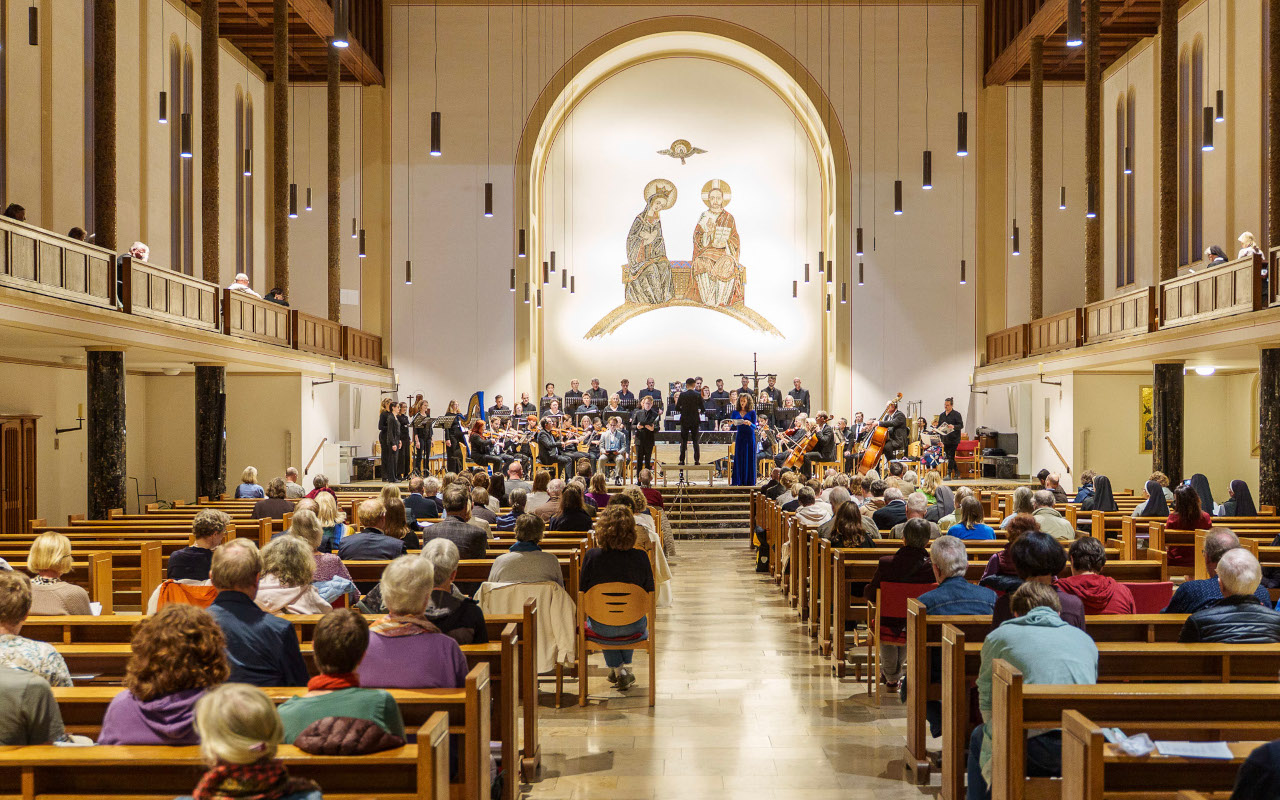
The beginning of Advent is celebrated in the Motherhouse Church in Münster with a particularly solemn vespers service. During the service, a priest lights the first candle on the Advent wreath while the Sisters sing the song “Wir sagen Euch an den lieben Advent…” (We announce to you the beloved Advent…). For several years now, a festive charity concert with Christmas carols has also been held in the Motherhouse Church in aid of Johannes Hospice in Münster. 400 candles burned at the “Christmas Carols 2025” on December 7, 2025, with the Münster Concert Choir; many children also took part. The impressive light show and our organist Markus Schröder also contributed to the great success of the concert.

I remember a tradition from my elementary school days: during Advent, every child who had done a good deed placed a straw in the manger so that the divine child could be softly bedded at Christmas.

Sister M. Benedikte

What would Advent be without cookies? At our Motherhouse in Münster, our Vietnamese Sisters baked lots of cookies with Sister M. Vera and then decorated them with chocolate with Sister M. Rita in the Generalate kitchen. The Sisters also traveled to the convent in Kroge for an Advent visit.

Poland

In many areas of Poland, children symbolically bring light to people’s homes, and nativity scenes and Advent cribs are lovingly crafted in monasteries. The Sisters of our Polish Province offer spiritual and material assistance by organizing Christmas packages for the needy, and offering meetings and conversations with socially marginalized people.

One of the most characteristic features of Advent in Poland is the Rorate Mass – a liturgy celebrated in honor of the Blessed Virgin Mary in the early hours of the morning, usually before sunrise. Participants bring candles or lanterns symbolizing the expectation of the coming “Light of the World” – Jesus Christ.

Sister M. Teresa

In Oldrzychowice in our Polish Province, Sister M. Franciska Wanat and several volunteers organized a visit from St. Nicholas for children affected by the flood disaster of September 2024. Fifty-two children took part in the event and spent a wonderful afternoon together.

USA

In the USA, Advent calendars have 25 doors because Christmas is not celebrated on Christmas Eve, but on Christmas Day, December 25.

I love to sing Advent songs to prepare for the coming of our Lord. I discovered Handel’s Messiah about 40 years ago and listen to it often. When I was a child the crib was very special in our home. In the Novitiate we practiced the spiritual building of the crib with special thoughts each day. 

Japan

In our convent in Himeji, we have been using purple and pink candles for about 20 years, which we brought back from the Korean mission. Purple represents repentance, pink represents joy. As the colors of the candles change from three deep purple to three light purple and then to one pink candle, Christmas draws nearer.

Our community has adopted the tradition of the Missionaries of creating a “spiritual manger.” We prepare to welcome Christ by building this manger and laying “straw” in our hearts, gathering prayers, sacrifices, and good deeds.

Sister M. Laetitia

Indien

In some regions of India, rose cookies, kulkuls, and fruit bread are baked during Advent. Through social media and parish groups, many also take part in charity activities and outreach programs, making Advent a time not only for spiritual preparation but also for sharing love and joy with others.

In India, a land rich in prayer, color, and celebration, we understand deeply what it means to wait with expectation — for the monsoon rains, for the harvest, for light to overcome darkness. As we light the Advent candles, I am reminded of the diyas (lamp) we light during Diwali — both shining as symbols of hope and the triumph of light over darkness, of God’s presence in our lives.

To all my sisters around the world: may this Advent help us rediscover the beauty of waiting — not with anxiety, but with peace and trust. May our hearts become humble cradles of hope, ready to receive the Prince of Peace. And may our lives, wherever we are, shine like little lamps, spreading the warmth and light of Christ’s love to all we meet.

Sister M. Renita

We would like to thank the Sisters of our international Congregation who sent us information about Advent in their home countries: Sister M. Benedikte (Germany), Sister M. Teresa (Poland), Sister Janelle (USA), Sister M. Laetitia (Japan), and Sister M. Renita (India).

You might also be interested in:

Visual Portfolio, Posts & Image Gallery for WordPress

Pilgrims of Hope (11): Respect

The series “Pilgrims of Hope” is a monthly spiritual contribution to the Holy Year – a collaboration between the international Generalate of the Hospital Sisters of St. Francis and the Muenster-based German church publication “Kirche und Leben” (“Church+Life”). Our topic in November: Hope for Respect

Another year is drawing to a close. Beginning with All Saints’ Day and All Souls’ Day, November is traditionally a month in which we look back on our own lives and on the lives of those who came before us. It is often a reflective time. Many people think about what has become of their plans of the year’s beginning, and what they have already achieved in their lives overall. And when we light candles on the graves of our deceased loved ones, this gesture is also an expression of respect for their lives, and their achievements. This is also the case with us Hospital Sisters of St Francis.

The Sisters’ graveyard at the Motherhouse in Muenster/Germany on All Saints’ Day ©Michael Kestin

Our international Congregation’s 180-year history is marked by strong female leadership, pioneering spirit, and courage. In terms of their careers and their position in society, our Sisters were often ahead of their time. Women have always held leadership positions in the institutions founded by our Congregation. In their hospitals, not only was the care of patients entirely in the hands of the Sisters, but so was the overall management. For a long time, women in religious orders were able to realize their professional potential much more freely than women outside a convent: in Germany, for example, married women were not considered legally competent until 1969, and until 1977, if they wanted to get a job, they had to ask their husbands for permission. At that time, Sister M. Ambrosina Bettmer was in charge of St. Francis Hospital in Münster with a team of several hundred Sisters and civilian employees.

Traditionally, all the young women who joined our Congregation studied nursing – but depending on the positions and tasks that needed to be filled in the congregation, this training was often not the only one. This was the case for Sister M. Dietmara Ahlmann, born in 1937: when the order’s leadership decided in the early 1960s to provide dental care for the many Sisters in Münster “in-house,” Sister Dietmara was chosen for this task.

Dentist Sister M. Dietmara Ahlman in her practice at St. Francis Hospital

The trained nurse completed her high school diploma through adult education and, as the only woman in her year, studied dentistry at Münster University from 1968 onwards. As a dentist, she then cared for her fellow sisters for 35 years in a fully equipped practice in the basement of St. Francis Hospital. At the same time, she was active in the Provincial and General Administration from 1983 onwards and traveled to the Provinces and projects of our Congregation in Japan, Taiwan, Korea, India, the USA, Haiti, Arizona, Poland, and Czechia.

General Councilor Sister M. Dietmara (2nd from the right) visiting the Medical Sisters of St. Francis in India

Our Sisters were also characterized by a pioneering spirit, setting out into the world for missionary projects, combined with courage drawn from the strength of their faith. One example is the young women who, 100 years ago, in September 1925, left the American Province of the Hospital Sisters of St. Francis for Tsinan (now Jinan) in China to build a hospital there. Beforehand, there was an application process among the American Sisters for this mission, searching for volunteers “in good health and younger than 40”. It went without saying that they had to be trained nurses. Sixty-seven Sisters applied; five were ultimately selected. The youngest of them, 29-year-old Sister Evangelista Sanders, paid for her courage with her life: she died after only a year and a half of her service. However, the presence of the Hospital Sisters in China continued until the Sisters were expropriated and expelled by the Communist regime after World War II. Two of the Sisters fled to Shanghai, from where they were called to Japan in 1948 to take over a hospital in Nagasaki – the nucleus of today’s Japan Province.

Sister Engelberta Beyer and Sister Euphrosine Fischer in China, 1926

We remember all these Sisters with great respect. But our respect also extends to those of our fellow Sisters who had less eventful lives, and who served and continue to serve quietly and faithfully, whether in a hospital, a school, or a parish, whether in housekeeping or in contemplation and prayer. In keeping with the spirit of our patron saint, St. Francis of Assisi, we actually look upon the life of every human being with the greatest respect: each and every one of us is placed in this world with individual abilities and hopes, with goals and challenges. On our journey through life, sometimes we succeed, sometimes we don’t. That, too, is deeply human. So as we look back now in November, we should always appreciate our efforts – with respect, and with the eyes of love.

By Schwester M. Rita Edakkoottathil and Claudia Berghorn

This article was published in German, online and in print, in the Diocese of Muenster’s magazine, “Kirche+Leben” (Church+Life), in November 2025.

You might also be interested in:
Visual Portfolio, Posts & Image Gallery for WordPress

Pilgrims of Hope (9): Support

The series “Pilgrims of Hope” is a monthly spiritual contribution to the Holy Year – a collaboration between the international Generalate of the Hospital Sisters of St. Francis and the Muenster-based German church publication “Kirche und Leben” (“Church+Life”). Our topic in September: Hope for Support

A year ago, in mid-September 2024, large parts of Eastern Europe were hit by heavy rain and flooding. Many people lost their lives. In Poland, the region where the Hospital Sisters of St. Francis have been active since 1848 was particularly affected: when a dam broke, a flood wave poured into the Lower Silesian town of Ołdrzychowice Kłodzkie, home to the Motherhouse of our Polish Province. Roads, walls, cars, fences, and trees were simply swept away, and houses were flooded. When the water finally receded, the full extent of the devastation became apparent.

View from the Motherhouse of the Polish Province after the flood

At that time, the Provincial Superior of the Polish Province, Sister M. Maksymiliana Pilarska, was in Münster with a delegation of fellow Sisters to attend the General Chapter of the international Congregation. “Half of our group traveled back to our Motherhouse as quickly as possible,” she recalls today. What the Sisters found exceeded their worst fears. “The buildings were filled with water meters high. There was no electricity, no heating, no fresh water, no telephone, no internet.” Even a year later, the renovation work is still not complete.

Sister M. Stella Kowalska helped provide warmth and food

But looking back, it is not only horror that stands out, but also gratitude. “The support we received in this emergency situation was incredible – both locally and internationally.” This support came from neighbors, people from the region, the Polish government, the Sisters’ families, and the international Congregation. “The Generalate, our International Leadership in Münster, procured generators, drying equipment, and materials that were immediately sold out in our region,” reports Sister Maksymiliana. “They also provided medicine, water, food, and much more.” The German Province of the Congregation, the St. Franziskus Foundation, and the St. Antonius Parish in Münster also participated in the emergency aid, as did the shipping company Fiege Healthcare Logistics, which provided transportation. Urgently needed financial aid also came from Münster and from many people in Poland and around the world. By November 2024, the Sisters had received 369 monetary donations, both small and large. The Sisters shared their materials and funds with other affected people in the area. “We would like to once again express our heartfelt thanks to all our supporters,” emphasizes Sister Maksymiliana.

Provincial Superior Sister M. Maksymiliana Pilarska after chopping wood for the stoves

“The fact that we can help each other in times of need is one of the great gifts of our internationality,” says the Superior General of the Mauritzer Franciscan Sisters, Sister M. Margarete Ulager. However, the Franciscan Sisters’ worldwide aid is not limited to acute situations or to their own community. The sisters in the USA, who have been active in health care since 1875 and have founded many hospitals in the Midwest, have launched “Mission Outreach”: Based in Springfield, Illinois, the organization addresses the urgent medical needs of people in resource-poor areas around the world by collecting medical supplies and equipment from US hospitals, sorting them, repairing them if necessary, and then distributing them to hospitals and medical aid organizations worldwide. Mission Outreach’s biomedical engineering department tests and manages 700 medical devices and their associated consumables each year. The organization can count on the support of more than 300 volunteers to pack, inventory, and ship the relief supplies.

“Mission Outreach” is supported by more than 300 volunteers

Since its founding in 2002, it has saved more than $85 million worth of medical supplies and equipment that would otherwise have ended up in landfills. It has already supported 530 medical aid organizations worldwide; and in August 2024, the Mission Outreach team was delighted to reach its 100th country with a delivery to Burundi.

“What can I personally do to alleviate suffering – here and now, with my resources and capabilities?” This question already moved our namesake, St. Francis of Assisi, 800 years ago. He gave away all his worldly possessions and dedicated his life to serving God, and the sick and marginalized. Inspired by his example, we Hospital Sisters have been searching for new answers to this question ever since our Congregation was founded in 1844. And we have gratefully accepted the support we have been given. For example, from Leoś, a 10-year-old Polish boy: with the money he received as a gift for his First Communion, he bought a dehumidifier for the Sisters in Ołdrzychowice Kłodzkie.

By Sister M. Beata Kapica and Claudia Berghorn

This article was published in German, online and in print, in the Diocese of Muenster’s magazine, “Kirche+Leben”(Church+Life), in September 2025.

You might also be interested in:
Visual Portfolio, Posts & Image Gallery for WordPress